SMALL BY DESIGN Deep care. Honest fit. Relationships that last. Why we stay small →
Menu
Request a Consultation
← All High School Admissions journeys
ANONYMIZED CLIENT JOURNEY · H10

T.S.

New Jersey transfer student / Chemistry and community contribution / Rebuilding continuity after a family move

T.S. had changed schools, lost activity continuity and spent months staying out of view. His application reconstructed the timeline honestly and showed how he rebuilt participation through ordinary responsibilities. Admitted to Lawrenceville, Lake Forest and Milton, he chose Milton only after comparing the offer with the value of remaining where he was.

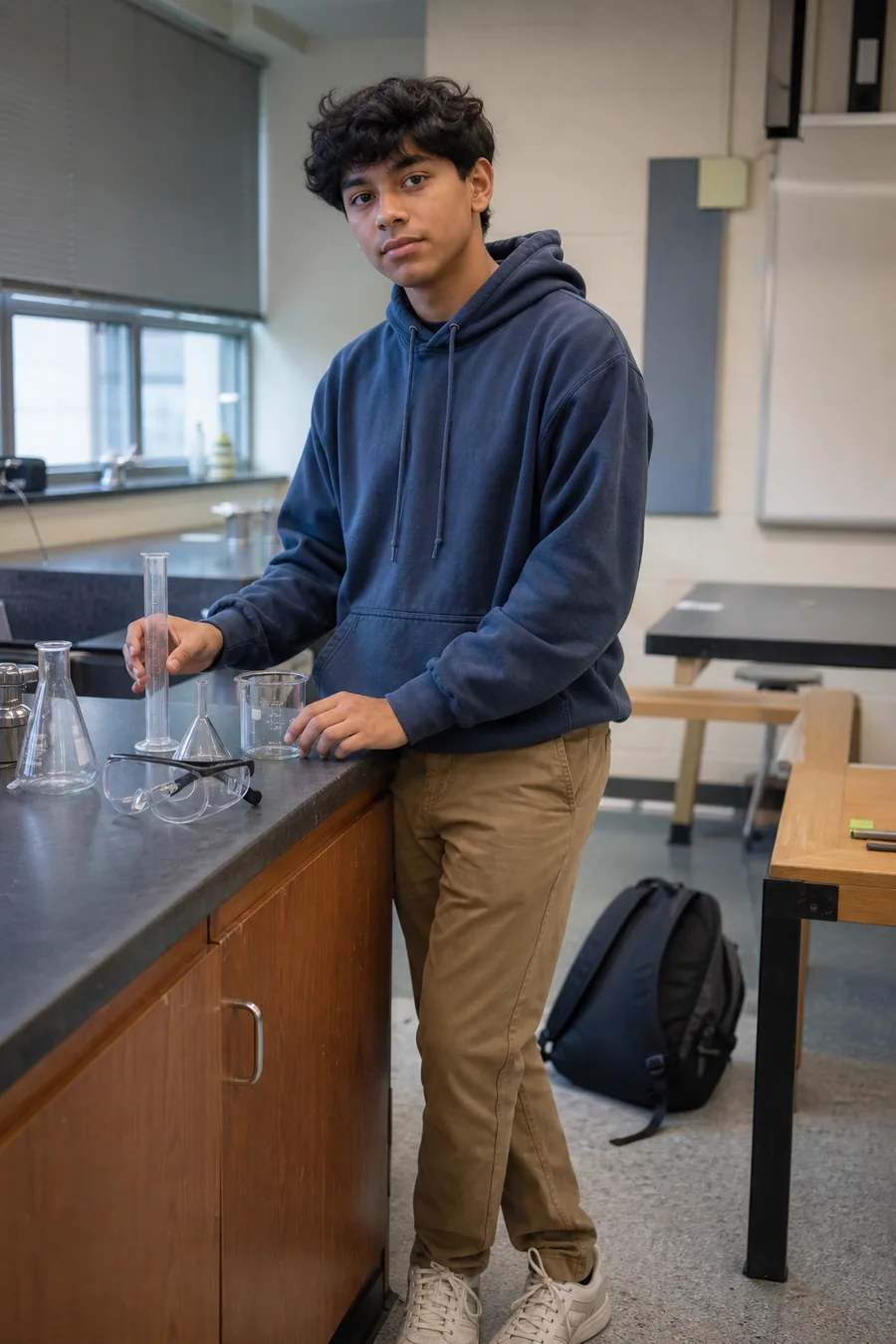
AI-generated representative image; it does not depict the client.
AT A GLANCE

The context behind the decisions.

Entry point
Grade 10 boarding-school admission
Background
Student who transferred between New Jersey public schools after a family move
Academic direction
Chemistry, mathematics, cooking and peer support
Ordinary complication
Disrupted recommendations, one incomplete activity year and no long record of formal leadership
Family consideration
Whether boarding would create stability or add another transition
Support emphasis
Timeline reconstruction, teacher relationships, realistic activity framing and residential fit
Acceptances
The Lawrenceville School; Lake Forest Academy; Milton Academy
Other result
Rejected by Groton School
Final choice
Milton Academy
EXTENDED CASE ANALYSIS

Continuity rebuilt one ordinary task at a time

T.S.’s application became trustworthy when it preserved the interrupted timeline and treated another school move as a decision to justify—not an automatic form of progress.

THE STARTING READ

A strong student with a broken timeline

T.S. moved midway through eighth grade when a parent's job changed. The transfer separated him from teachers who knew him well and interrupted participation in a cooking club and peer-tutoring program. At the new school he performed strongly in mathematics and chemistry but spent several months avoiding activities because he expected another disruption. His eventual contribution was ordinary and useful: helping classmates review algebra and organizing materials for a teacher's laboratory demonstrations.

The family considered boarding school partly because it could provide continuity. T.S. worried that presenting the move as hardship would be dishonest; the family remained stable, and the transition had been difficult without being traumatic.

THE CENTRAL DIAGNOSIS

The months that could not be smoothed away

What the application already showed

  • Strong mathematics and chemistry work
  • Practical interests in cooking and laboratory preparation
  • Gradual re-engagement after a disruptive transfer

What it did not yet answer

  • Could the activity timeline be reconstructed accurately?
  • Would boarding create stability or add another transition?
  • How did T.S. move from self-protection toward participation?
THE INTELLECTUAL CENTER

Routine, re-entry, and the purpose of another move

The questions below did not supply an admissions formula. They determined what evidence needed to be checked, which claims needed limits, and what the applicant still had to decide.

What happens when a student expects continuity to disappear?

Expecting another disruption led T.S. to stay out of activities; the inactive months showed self-protection rather than a continuous record of engagement.

How is routine rebuilt?

Routine returned through cooking, algebra help, and organizing laboratory materials—small tasks whose repetition made participation possible again.

When does another move serve a clear purpose?

Another move served a purpose only if the boarding environment offered something clear enough to outweigh relationships finally forming at the current school.

THE TURNING POINT

The same family dish did not work the same way in a new kitchen.

T.S.'s essay began with cooking the same family dish in two different kitchens. Early drafts used the move as a neat metaphor; later drafts included the irritation of unfamiliar equipment, missing ingredients and his reluctance to ask neighbors for help. The story became about rebuilding routine through small acts rather than declaring that food solved the transition.

School research compared residential stability, access to day students and local community, laboratory coursework, advising and the experience of entering after Grade 9. T.S. interviewed adults at each school about how new students join existing groups. He also considered whether remaining in his current public school, where relationships were finally forming, might be the better decision.

SELECTING EVIDENCE

The facts stayed the same. Their hierarchy changed.

Evidence was made more precise, attributable, and useful. The goal was not to enlarge the record, but to stop one title, institution, hardship, or outcome from carrying more meaning than it could support.

Earlier presentation

Activities from two schools appeared continuous.

Stronger presentation

Dates, interruptions, and later re-entry were presented accurately.

Earlier presentation

The inactive months looked like empty space.

Stronger presentation

They became part of an honest account of uncertainty and recovery.

Earlier presentation

Boarding appeared to offer automatic stability.

Stronger presentation

The offer was compared with the real value of staying.

APPLICATION CONTEXT

Recommendations across two New Jersey schools

The application timeline contained gaps that could easily be filled with vague language. T.S. initially combined the two schools' activities as though they had continued uninterrupted. Reconstructing dates produced a less impressive but more accurate record. It also revealed that the months of non-participation were part of the story: he had responded to uncertainty by staying invisible, then gradually chosen to engage again.

Recommendation planning required more than selecting the teacher at the new school with the most prestigious subject. One former teacher could describe T.S. over several years, while a current chemistry teacher had observed his recent recovery. Coordinating those perspectives within school rules helped the file show both continuity and change.

STUDENT OWNERSHIP

Independence remained visible in the work.

  • T.S. verified dates and wrote the application. His parents supplied move details but did not characterize the experience for him. The mentor did not inflate peer help into a tutoring organization or turn a normal family transition into a dramatic adversity narrative.
OUTCOME & DECISION

Choosing another transition only after testing the option to stay

T.S. was admitted to Lawrenceville, Lake Forest and Milton and denied by Groton. He selected Milton because the mix of boarding and day students, proximity to a city and the school's academic range felt like continuity without isolation. The choice was reached only after he compared the offer with staying at his current school and decided that the new transition served a clear educational purpose.

WHAT CHANGED

  • The activities from two schools were separated into an accurate timeline.
  • Months of withdrawal became part of the explanation rather than hidden space.
  • Teacher selection captured both longer continuity and recent recovery.
  • The family treated staying at the current school as a serious alternative.

WHAT DID NOT CHANGE

  • The family move remained disruptive without being described as trauma.
  • The activity record still contained an incomplete year.
  • Peer help did not become a formal tutoring organization.
  • Another move still carried its own adjustment cost.
HOW THE FILE BECAME LEGIBLE

The reader’s understanding changed in stages.

This sequence describes what the revised evidence made easier to understand. It does not claim to reconstruct an admissions committee’s private deliberations.

Academic record

A strong mathematics and chemistry student whose transfer disrupted continuity.

Timeline reconstruction

A student who stayed invisible for several months rather than moving seamlessly between schools.

Gradual re-entry

Someone rebuilding routine through peer help, cooking, and practical laboratory support.

Boarding decision

A family accepting another transition only after defining its educational purpose.

WHAT COULD HAVE WEAKENED THE CASE

The alternatives were plausible—and less useful.

Combine activities from both schools

The record would appear stronger while obscuring the actual interruption and response.

Turn the move into dramatic adversity

A normal but difficult family change would be made emotionally larger than the facts support.

Choose recommenders by subject prestige

The file could lose the perspectives needed to show both continuity and recent recovery.

Assume boarding equals stability

The family might add a transition without defining the academic benefit it served.

DECISION DISCIPLINE

Each stage used a different test.

DecisionHow it was tested
How to rebuild the timelinePreserve dates, gaps, and the moment of re-entry rather than blending two school records.
Which recommendations to seekCombine a longer view from the former school with recent evidence from the current one where rules allow.
How to write about the moveUse ordinary disruption and routine without claiming trauma or a complete recovery arc.
Whether to boardCompare the offer directly with the real value of relationships already forming at the current school.

WHAT THIS CASE SUPPORTS

  • T.S. could reconstruct the interrupted timeline accurately.
  • He gradually re-entered school life through useful, modest responsibilities.
  • The family compared boarding with the legitimate option of staying.

WHAT IT CANNOT PROVE

  • That the family move constituted severe adversity.
  • That ordinary peer assistance was a formal program.
  • That boarding would automatically create lasting stability.
QUESTIONS FOR A SIMILAR APPLICANT

Questions for an interrupted record

The profile shows how one applicant’s evidence and decisions were organized. It does not predict another person’s result or supply a story to copy.

  • Which gap in your record has been made to look smoother than it was?
  • Who knew you well before the interruption, and who has seen you recover?
  • What small responsibility brought you back into a community?
  • What educational gain would make another move worth its disruption?
  • If you stayed, what relationships or opportunities would continue to grow?
T.S.’s journey became persuasive not because he moved on quickly, but because he could show how continuity was lost, rebuilt, and evaluated before another move. Not every disruption needs to become adversity branding. T.S.'s application worked by documenting an interrupted timeline, showing gradual re-engagement and treating the option to stay as legitimate. A boarding-school decision was valuable because it was examined, not because movement itself was assumed to be progress.
CONTINUE EXPLORING
High School AdmissionsAll 40 client journeysAll student results
YOUR NEXT STEP

Your application should still sound and feel like your own.

We will listen carefully and tell you whether we believe Letrado is the right fit. If another resource would serve you better, we will be honest about that too.

See If We Are a Fit