Practice without performance
J.P. became more convincing when music and physics were allowed to remain genuine, partly separate interests—and when fluent interviewing stopped meaning memorized interviewing.
Seven years of cello and no need for a prize
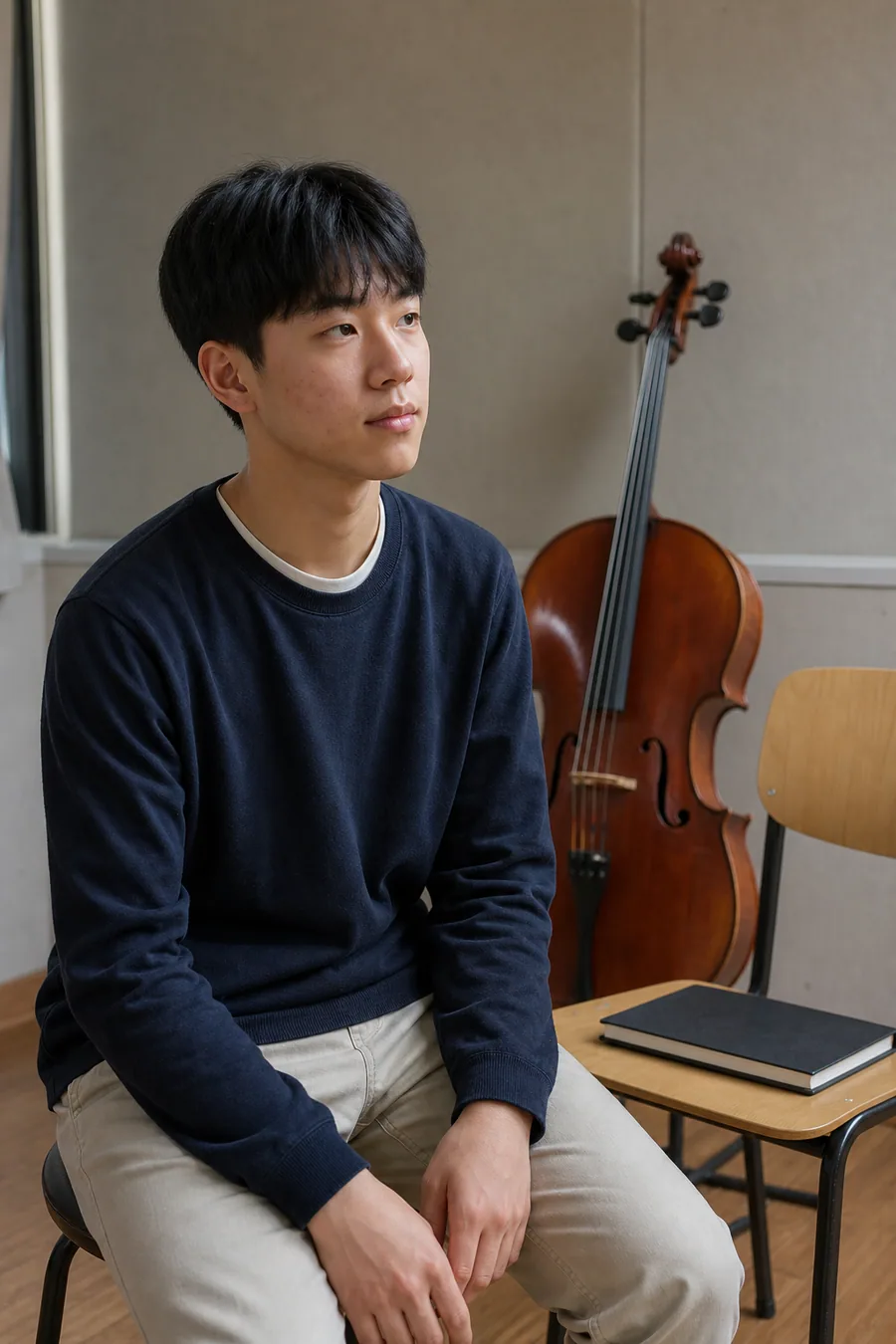
J.P. had studied cello for seven years and enjoyed physics, yet he felt pressure to present both interests as evidence of exceptional achievement. In reality, music was an important long-term discipline but not a national-level credential. His first interview responses sounded memorized, and his parents preferred East Coast schools even though J.P. was curious about a smaller Western setting and outdoor education.
The goal was to make the file more truthful and more personal at the same time. That meant letting sustained interest matter without claiming that every activity had produced a prize, organization or measurable impact.
When polish made J.P. harder to hear
What the application already showed
- Sustained musical discipline
- Strong academic preparation and serious interest in physics
- Willingness to consider meaningfully different school settings
What it did not yet answer
- Could J.P. respond naturally when he had not planned the sentence?
- Did music need to be an achievement credential to matter?
- Was the family’s East Coast preference aligned with his priorities?
Patience, uncertainty, and two genuine interests
The questions below did not supply an admissions formula. They determined what evidence needed to be checked, which claims needed limits, and what the applicant still had to decide.
What does sustained practice teach when it does not produce a major prize?
Sustained practice mattered through the patience and revision of seven years, not through a conservatory-level distinction that J.P. had not earned.
How does J.P. respond when precision is not immediately available?
When precision was unavailable, both laboratory work and spoken English asked him to pause, tolerate uncertainty, and keep thinking.
Can two interests coexist without becoming one artificial theme?
Music and physics could coexist because they were real parts of his life; they did not need to become one invented interdisciplinary project.
The strongest version kept the frustration in the story.
J.P. reviewed schools through class size, music access, science facilities, residential structure and geography. The list retained distinct options instead of producing minor variations on one school. Interview work moved away from scripted paragraphs. He practiced answering the same question from different starting points, asking for clarification when needed and allowing a short pause before responding.
The main essay connected the physical patience of tuning an instrument with the slower process of understanding an unsuccessful lab result. Early drafts relied on polished metaphors; later drafts included concrete moments, small frustrations and an honest admission that he sometimes abandoned an idea too quickly. Parent conversations clarified that J.P. would make the final educational choice within the family's financial parameters.
The facts stayed the same. Their hierarchy changed.
Evidence was made more precise, attributable, and useful. The goal was not to enlarge the record, but to stop one title, institution, hardship, or outcome from carrying more meaning than it could support.
Music was framed through the distinction it had not produced.
Seven years of practice mattered through duration and discipline.
Physics and cello were pushed toward one polished identity.
They remained separate interests linked by patience and revision.
Interview success meant delivering a prepared paragraph.
Success meant understanding the question, pausing, and responding in real time.
An interview language and a family geography
J.P. had learned English in classrooms where correctness mattered more than spontaneity. He could prepare an elegant answer, but an unexpected follow-up made him retreat into short phrases. His parents interpreted polished answers as evidence of readiness; interview practice showed that the greater strength would be responding naturally when he had not planned the exact sentence. Progress was uneven. Some sessions felt more awkward before they became more conversational.
His school search also forced a question about identity. At home, relatives described him as “the musician,” while teachers thought of him as a science student. J.P. did not want to abandon either interest, but he also did not want a school to admit a simplified version of him. The file needed enough coherence to be memorable without turning two genuine interests into a manufactured interdisciplinary project.
Independence remained visible in the work.
- J.P. drafted in English and kept expressions that sounded natural to him, even when a more sophisticated phrase was available. Feedback focused on intelligibility, structure and whether examples supported the point. The process did not turn his cello study into an award he had not earned.
A school where neither interest had to become an identity
J.P. was admitted to St. Paul's, Cate and Deerfield and waitlisted at Choate. He chose Cate after weighing its scale, access to nature, science program and the possibility of continuing music without making it his sole identity. His parents supported the choice after reviewing travel and residential arrangements.
WHAT CHANGED
- Interview preparation moved from scripts to responsive conversation.
- Long musical commitment stood on its own without competitive decoration.
- The essay retained failure and impatience rather than smoothing them away.
- J.P.'s interest in a smaller Western setting received equal weight with family preference.
WHAT DID NOT CHANGE
- J.P. remained a strong student whose spoken English could become cautious under pressure.
- Cello did not become a national-level credential.
- Physics and music remained separate interests.
- Travel and residential arrangements still required parental confidence.
The reader’s understanding changed in stages.
This sequence describes what the revised evidence made easier to understand. It does not claim to reconstruct an admissions committee’s private deliberations.
A strong student with physics interest and long musical training.
An applicant whose elegant preparation became brittle under an unexpected question.
A student learning to remain with an imperfect experiment, phrase, or answer.
J.P. wanted room to continue both interests without being reduced to either one.
The alternatives were plausible—and less useful.
Present cello as an elite credential
The application would distort the level of achievement and miss what long practice actually taught.
Memorize every likely interview answer
Unexpected follow-ups would expose preparation as inflexibility rather than confidence.
Build a music-and-physics project for coherence
A late construction would make two genuine interests feel strategically packaged.
Follow the East Coast preference automatically
J.P.'s interest in scale, setting, and outdoor education would never receive a fair comparison.
Each stage used a different test.
| Decision | How it was tested |
|---|---|
| How to value cello | Use duration, practice, and honest reflection rather than a missing prize. |
| How to build interview confidence | Vary starting points, allow pauses, and practice asking for clarification. |
| How to connect interests | Connect habits only where the evidence supports them; preserve disciplinary difference. |
| How to choose a school | Compare scale, science, music, geography, and residential life as distinct trade-offs. |
WHAT THIS CASE SUPPORTS
- J.P. sustained cello study over many years.
- He could reflect on frustration in both practice and academic work.
- He became more capable of answering without a memorized paragraph.
WHAT IT CANNOT PROVE
- That cello achievement reached conservatory or national distinction.
- That music caused his interest in physics.
- That interview growth changed his underlying personality.
Questions for the over-rehearsed applicant
The profile shows how one applicant’s evidence and decisions were organized. It does not predict another person’s result or supply a story to copy.
- What happens to your answer when the follow-up is not on your practice sheet?
- Which commitment would still matter if no prize ever came from it?
- Where have you mistaken polished language for honest reflection?
- Can two interests remain side by side without a clever bridge between them?
- Is your preferred setting genuinely yours or inherited from family assumptions?
J.P.’s profile gained depth when sustained practice was allowed to matter without a prize and when an imperfect answer became more valuable than a perfect script. Long-term commitment is valuable even when it does not culminate in a national prize. J.P.'s application allowed music and physics to remain separate, genuine interests and made interview growth visible without claiming a personality transformation. School choice gave him room to explore beyond both labels.