SMALL BY DESIGN Deep care. Honest fit. Relationships that last. Why we stay small →
Menu
Request a Consultation
← All High School Admissions journeys
ANONYMIZED CLIENT JOURNEY · H8

R.K.

Dubai-based Indian student / Architecture and visual thinking / Portfolio confidence without formal art awards

R.K. had years of sketchbooks and a serious interest in architecture, but no formal awards and no reason to manufacture a last-minute project. His application emphasized process, course continuity and the realities of entering in Grade 11. Admitted to Choate, Loomis Chaffee and Peddie, he chose Loomis for academic and transition fit.

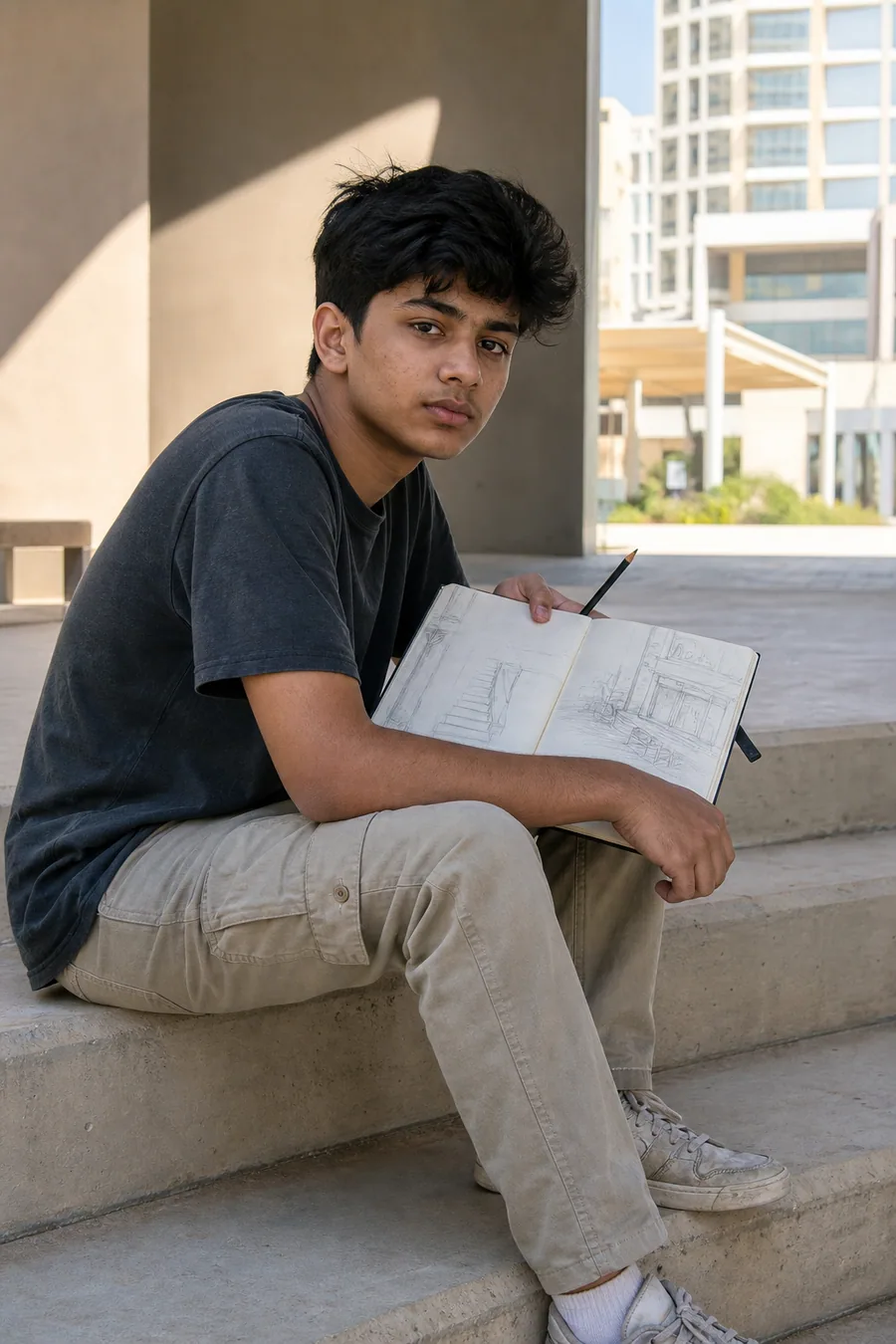
AI-generated representative image; it does not depict the client.
AT A GLANCE

The context behind the decisions.

Entry point
Grade 11 boarding-school admission
Background
Indian student at an international school in Dubai
Academic direction
Architecture, geometry, visual art and urban observation
Ordinary complication
Strong sketchbooks but no juried awards, a crowded junior-year schedule and uncertainty about entering at Grade 11
Family consideration
Preserving curricular continuity and avoiding a move driven only by university strategy
Support emphasis
Portfolio boundaries, late-entry fit, course mapping and interview authenticity
Acceptances
Choate Rosemary Hall; The Loomis Chaffee School; The Peddie School
Other result
Rejected by The Lawrenceville School
Final choice
The Loomis Chaffee School
EXTENDED CASE ANALYSIS

The unfinished page said more

R.K.’s strongest creative evidence was not a polished portfolio or a last-minute campaign. It was the repeated habit of observing, testing, correcting, and asking how people actually used a space.

THE STARTING READ

Years of looking without a formal portfolio label

R.K. filled sketchbooks with staircases, shopfronts and the temporary structures he noticed around construction sites. He enjoyed geometry and visual art but had never entered a major competition or completed a formal architecture program. His school offered the IB Diploma, and moving before Grade 11 created a real curricular decision rather than a simple transfer. A boarding-school application could expand opportunity, but it could also interrupt a program that already worked.

His first portfolio selection included finished drawings chosen because they looked impressive. The more revealing pages were messier: alternative floor plans, proportions he had corrected and notes about why a public space felt difficult to navigate.

THE CENTRAL DIAGNOSIS

When polish hid the design question

What the application already showed

  • Sustained visual observation
  • Strong interest in geometry and urban space
  • A large body of self-directed sketchbook work

What it did not yet answer

  • Did the portfolio reveal process or only polished output?
  • Was architecture an authentic interest or an admissions identity?
  • Did moving offer educational value beyond university strategy?
THE INTELLECTUAL CENTER

Observation, use, and whether a move was worth it

The questions below did not supply an admissions formula. They determined what evidence needed to be checked, which claims needed limits, and what the applicant still had to decide.

What does a drawing reveal about how the applicant thinks?

A drawing revealed R.K.'s thinking when corrections, alternative proportions, and written questions remained visible beside the finished image.

How do people change the meaning of a designed space?

People changed the meaning of designed space through the improvised structures and daily adaptations he repeatedly noticed.

When is a major educational move justified?

A major move was justified only if studio access, small discussions, and residential community improved his present education rather than merely signaling future university ambition.

THE TURNING POINT

The moving bus made perfect observation impossible.

R.K. built a concise visual supplement that showed process rather than a professional portfolio. Each selection included a short factual caption: what he observed, what medium he used and what changed between versions. No drawing was presented as an architectural commission or community intervention. Course mapping compared how each school would recognize prior work and support entry into an established Grade 11 cohort.

His main essay followed repeated attempts to sketch a pedestrian bridge from a moving bus. The subject forced him to notice how memory fills gaps inaccurately. The final version connected observation, error and revision without claiming that drawing had produced a complete theory of cities. Interviews explored what he would contribute beyond art and how he would respond if architecture stopped being his primary interest.

SELECTING EVIDENCE

The facts stayed the same. Their hierarchy changed.

Evidence was made more precise, attributable, and useful. The goal was not to enlarge the record, but to stop one title, institution, hardship, or outcome from carrying more meaning than it could support.

Earlier presentation

The portfolio favored finished facade drawings.

Stronger presentation

Process pages, corrections, and alternative plans carried equal or greater weight.

Earlier presentation

Ordinary observation felt insufficient.

Stronger presentation

Repeated attention became more credible than a rushed campaign.

Earlier presentation

Boarding school was framed as strategic advancement.

Stronger presentation

The move was tested against curriculum, studio access, and community.

APPLICATION CONTEXT

A Grade 11 transfer across curricula

R.K. worried that ordinary observation was not enough. Online examples made every young designer appear to have founded a community project or won an international prize. He briefly proposed turning his sketches into a last-minute accessibility campaign. The process redirected him toward work he had actually sustained and questions he genuinely wanted to explore.

The family also needed to test the reason for moving. Some conversations framed boarding school as a strategic step toward U.S. university admission. R.K. was more interested in studio access, smaller discussions and living with peers. If those educational differences were not compelling on their own, changing countries and curricula would not be justified.

STUDENT OWNERSHIP

Independence remained visible in the work.

  • R.K. chose and captioned every image, retained unfinished work and declined to create a rushed service project. His school confirmed curriculum details. Guidance supported selection and explanation; it did not redesign the work or present him as a trained architect.
OUTCOME & DECISION

Choosing the clearest transition, not the grandest claim

R.K. was admitted to Choate, Loomis Chaffee and Peddie and denied by Lawrenceville. He chose Loomis after comparing visual-arts access, course continuity, community scale and how each school supported older entrants. Choate remained attractive academically, but the Loomis transition plan felt more concrete to both R.K. and his family.

WHAT CHANGED

  • Process pages became as important as finished drawings.
  • Portfolio captions separated observation from speculation.
  • The proposed last-minute accessibility campaign was abandoned.
  • Boarding school was tested as an educational choice rather than a university tactic.

WHAT DID NOT CHANGE

  • R.K. had no juried art or architecture award.
  • His sketches remained personal observations rather than commissions.
  • The existing IB pathway remained a credible alternative.
  • Entering an established Grade 11 cohort still required careful transition planning.
HOW THE FILE BECAME LEGIBLE

The reader’s understanding changed in stages.

This sequence describes what the revised evidence made easier to understand. It does not claim to reconstruct an admissions committee’s private deliberations.

Finished work

A visually capable student with an interest in architecture and no formal award record.

Sketchbook process

An observer whose mistakes, corrections, and questions revealed the deeper work.

Portfolio boundary

A student willing to present development without pretending to be a professional designer.

Transfer decision

A family comparing tangible educational gains against curricular disruption.

WHAT COULD HAVE WEAKENED THE CASE

The alternatives were plausible—and less useful.

Submit only the most polished drawings

Visual skill would be visible while the reasoning and revision behind it disappeared.

Create a late accessibility initiative

A sustained private habit would be replaced by a thin public project designed for the application.

Describe sketches as design solutions

Observation and speculation would be confused with tested work.

Treat boarding as a direct university advantage

The family could overlook whether course continuity and daily education justified the move now.

DECISION DISCIPLINE

Each stage used a different test.

DecisionHow it was tested
What to include in the supplementSelect work that exposes observation, failed choices, and revision—not just finish.
How to write captionsState what R.K. saw, which medium he used, and what changed without claiming intervention.
Whether to transferCompare studio access, discussions, residence, and curricular continuity with the current IB path.
Which offer fit bestPrioritize the clearest course and community transition for an older entrant.

WHAT THIS CASE SUPPORTS

  • R.K. sustained a habit of visual observation and revision.
  • He could distinguish process evidence from a professional portfolio claim.
  • The family evaluated whether a disruptive move served his current education.

WHAT IT CANNOT PROVE

  • That R.K. had professional architecture training.
  • That his observations amounted to an accessibility intervention.
  • That boarding school would improve a later university outcome.
QUESTIONS FOR A SIMILAR APPLICANT

Questions to put beside the sketchbook

The profile shows how one applicant’s evidence and decisions were organized. It does not predict another person’s result or supply a story to copy.

  • Which page best shows a decision changing rather than a drawing succeeding?
  • What did you see directly, and what did memory or assumption add?
  • How do people use the space differently from its apparent design?
  • Would you still want to transfer if university strategy were removed from the discussion?
  • Which course or sequence might be disrupted by Grade 11 entry?
R.K.’s application became more sophisticated when unfinished work was allowed to show the thinking that finished drawings had hidden. Creative applicants do not need to imitate professional portfolios. R.K.'s strongest evidence was the sustained habit of noticing and revising. The application also tested whether a disruptive educational move was worthwhile rather than assuming that a boarding-school offer automatically improved his path.
CONTINUE EXPLORING
High School AdmissionsAll 40 client journeysAll student results
YOUR NEXT STEP

Your application should still sound and feel like your own.

We will listen carefully and tell you whether we believe Letrado is the right fit. If another resource would serve you better, we will be honest about that too.

See If We Are a Fit