SMALL BY DESIGN Every student gets our full attention. Read our story →
All graduate guides

JOHNS HOPKINS · MSE IN BIOMEDICAL ENGINEERING GUIDE

Weighing one year or two at Johns Hopkins? Budget for both, because a thesis year depends on a lab taking you after you enroll.

Johns Hopkins’ full-time Master of Science in Engineering (MSE) in Biomedical Engineering typically takes one year of courses, or two with a thesis. Its department belongs to both the Whiting School of Engineering and the School of Medicine.

Fall 2027 entry

A long red-brick building with white trim and chimneys behind bare winter trees, across a wide lawn in late-afternoon light
Clark Hall, Biomedical Engineering’s home on the Homewood campus · Photo: Chris Rycroft / Wikimedia Commons, CC BY 2.0. Resized and cropped.

GET TO KNOW THE PROGRAM

Take a year of graduate courses, then decide whether to stay for a thesis.

The MSE is full time, on campus, and starts only in the fall. The department names Abbott, Genentech, Medtronic, and Moderna among the places recent graduates work.

YEAR ONE

Complete 30 credits of graduate coursework.

Choose approved graduate courses from across Johns Hopkins. Up to six research credits and two seminars can count.

APRIL 1, YEAR ONE

Decide whether to add a thesis year.

Declare the thesis route by April 1 of your first year, and find a lab that confirms your place. Otherwise, you graduate when the coursework is done.

THE THESIS YEAR

Spend your second year on full-time research.

A Johns Hopkins faculty member advises you, and three faculty members review the thesis. The lab can be outside biomedical engineering.

Look for a lab on the medical campus too, not only at Homewood.

The MSE is based in Clark Hall, on the Homewood campus. The department’s faculty also run labs in five research buildings on the School of Medicine campus in East Baltimore.

Courses and focus areas

Courses that count: Graduate courses from across Johns Hopkins in math, science, engineering, or medicine and public health, usually in the 600s or 700s. A 400-level course can count when no 600-level match is taught.

Research and seminars: With a confirmed lab, up to six research credits (three a semester, about 12 lab hours a week) and two seminars can count.

Focus areas: Encouraged, not required: AI in Medicine, Biomedical Data Science, Computational Medicine, Genomics & Systems Biology, Imaging & Medical Devices, Immunoengineering, Neuroengineering, or Translational Cell & Tissue Engineering.

Where you’ll live, and health insurance

Housing: There’s no on-campus housing for engineering graduate students, so you’ll rent off campus, with help from the off-campus housing office at Homewood.

Health insurance: Required for full-time students in an in-person course and for every F-1 or J-1 (exchange visitor) student. The university plan is billed automatically, and only students not on an F-1 or J-1 can waive it, each year.

If you’d study at Johns Hopkins on a student visa

Your I-20: After you accept your offer and pay any required deposits, OIS emails instructions, typically within five days. It reviews your request in iHopkins within 10 business days.

Proof of funds: Documents from the past three months covering your first year. OIS estimates $90,300 for a Whiting School master’s student, plus $7,200 for each dependent, without naming the start year.

The visa: Pay the $350 SEVIS (student records) fee before your visa is issued. You can enter the U.S. up to 30 days before your start.

Your classes: In person, though one course a semester can be online or hybrid.

A thesis year: Before you declare by April 1, ask OIS what a second year means for your I-20. The advising manual says MSE student visas typically last two years at most.

Working on campus: Up to 20 hours a week during classes, and a full stipend counts as 20. Full time during breaks and a vacation summer.

Internships and CPT: Don’t count on Curricular Practical Training (CPT) for an off-campus internship. This MSE requires none, and Johns Hopkins allows CPT only for training a degree requires, as U.S. guidance of August 24, 2026, does.

After you graduate: OPT needs a fall and a spring in F-1 status and approval before you work, so ask OIS when to file. The STEM extension adds a training plan and an employer enrolled in E-Verify.

A $70,000 fee for a first OPT, proposed by the U.S. Department of Homeland Security (DHS) on October 8, 2026, isn’t in force.

A red-brick Victorian building with a tall copper-green dome, behind iron gates and trees, under a blue sky with white clouds
The Johns Hopkins Hospital’s dome, on the East Baltimore medical campus · Photo: Art Anderson / Wikimedia Commons, CC BY-SA 3.0. Resized and cropped.

UNDERSTAND WHAT THE COMMITTEE LOOKS FOR

Lead with the core sciences, your hands-on research, and a clear reason for graduate study now.

Admitted students typically have a grade point average (GPA) of 3.7 or higher on a 4.0 scale, though there’s no minimum. The committee weighs your record, letters, motivation, and hands-on research together.

YOUR PREPARATION

Make sure your transcript covers the core sciences and some programming.

Successful applicants generally have college physics, chemistry, math, and biology, plus programming. The department takes engineering and basic-science degrees, and exceptional applicants from other fields.

Letrado’s adviceFrom a science degree? The 2026–27 catalogue says science graduates normally take some extra courses, so ask the department whether you’d need them.

YOUR RESEARCH

Describe your hands-on research, especially if a thesis interests you.

The committee calls research experience a major asset, above all for students who hope to join the thesis route after they enroll.

Letrado’s adviceList the methods you ran yourself on your résumé, and in your statement, say what you did when an experiment failed.

YOUR PURPOSE

Show why you want this degree now.

The committee looks for “a clear motivation to excel in graduate research and study.” Your statement is where you show it.

Letrado’s adviceName the work you want to do after the MSE and the skill you need the degree to build, so your motivation reads as a plan.

Course-based or thesis: which route fits your plans?

THE TWO ROUTES

Both routes start with the same 30 credits, and the thesis adds a year in a lab.

1 year

Course-based: 30 credits of coursework, then you graduate

2 years

Thesis: the same coursework, a thesis declared by April 1, a lab that confirms your place, then a year of research

The department says the MSE prepares you for industry, consulting, government, or clinical research, or for a PhD or MD/PhD.

The department’s pages don’t say whether you can switch back to the course-based route after declaring a thesis, so ask before you declare.

Your three letters, and help with your statement

WHAT YOU SIGN FOR

You may get help with your application, but you answer for the authenticity of every part.

The Whiting School’s authenticity rule makes you fully responsible for everything submitted under your name, and false or misrepresented information can cost you your admission, or later your Johns Hopkins credits and degree.

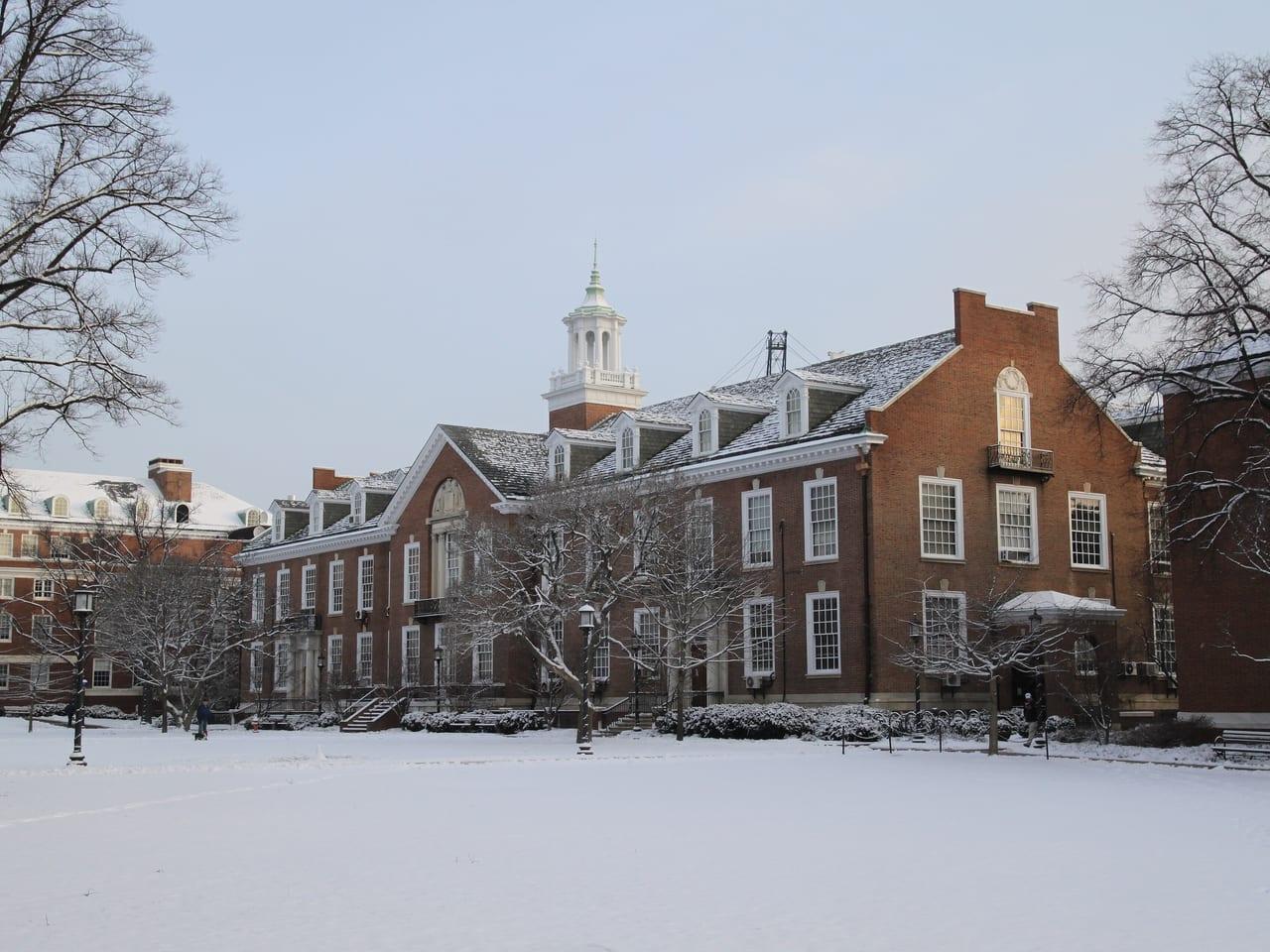
A red-brick building with a white cupola across a snow-covered lawn, framed by bare trees
Maryland Hall in snow, Homewood campus · Photo: Cvenghaus / Wikimedia Commons, CC BY-SA 3.0. Resized and cropped.

PLAN THE APPLICATION

The application is final once you submit it, so it has to be complete by the January 15, 2027, deadline at 11:59 p.m. Eastern Time.

The Whiting School’s Engineering Graduate Admissions office processes your application, not the department. Applying is free, and you don’t need the GRE (Graduate Record Examinations).

Virtual information session

Dec 2
Time
2 p.m.

Application deadline

Jan 15, 2027
Due by
11:59 p.m. Eastern
Fee
None

Typical decision timing

By March
Notice
Sent to every applicant

Facts checked against official pages on November 7, 2026.

Dates without a year are as Johns Hopkins lists them. The department gives no time zone for its information session, so check it when you register.

Have each piece ready before you submit.

  • The online application

    Through the Whiting School’s online system only.

  • Statement of interest and motivation

    Why you want graduate study in biomedical engineering.

  • Résumé

    Required. Show your engineering, lab, and programming experience.

  • Three recommendations

    From former instructors or employers who can speak to your potential.

  • Unofficial transcripts

    Enough to apply. Official ones are needed only once you’re admitted and enrolling.

  • An official English score, if you need one

    Needed if English isn’t the primary language of your country of citizenship, unless you qualify for a waiver.

The GRE, transcripts, and English tests

The GRE: Not required, and the committee won’t use scores you send.

Transcripts: Three-year and four-year bachelor’s degrees are treated the same, and other languages need certified English translations. A credential evaluation is optional, but from World Education Services (WES) it must be the course-by-course ICAP.

Your GPA: Ask admissions how to report grades from another system before you convert them to a 4.0 scale.

When you need scores: Before you can be admitted or issued visa documents, unless you’re a U.S. citizen or permanent resident.

Tests and scores: TOEFL, IELTS, Cambridge English, and Duolingo are accepted. The recommended minimums are 100 on the TOEFL iBT (or 5.0 on its 1 to 6 scale), 7 on IELTS Academic, 185 on Cambridge, and 135 on Duolingo. TOEFL, IELTS, and Duolingo scores expire after two years.

Duolingo: The department’s own page doesn’t list it, so check before you rely on it.

Waivers: Citizens of listed countries, such as Australia, Canada (except Quebec), Ireland, Nigeria, Singapore, or the United Kingdom, may qualify, as may graduates of degrees earned there and students with documented English-medium study. A waiver won’t cover an English check at a visa interview.

Interviews, accepting an offer, and deferring

Interviews and accepting an offer: The pages mention no interview, reply deadline, or deposit for this MSE, but OIS’s first I-20 step is paying any required deposits. Ask the department what it needs from you, and by when.

Deferring: Ask the department whether you can postpone your start. If you can, you’ll sign a Deferral Agreement form.

Questions to ask Johns Hopkins

Engineering Graduate Admissions: How to report grades from another country’s system.

The department: Whether your lab must confirm your place by April 1, and whether you can switch back after declaring a thesis. The second-year funding terms for fall 2027 entrants, in writing. Once you’re admitted, what it needs from you by when, and whether you can defer.

The financial aid office: Whether the $6,868 non-resident fee applies to you, including in a thesis year, and which federal loan limit is yours.

OIS, if you’ll need a student visa: Which CIP code this MSE carries, and what a thesis year would mean for your I-20.

A low glass pavilion with a flat roof, set on a wide brick-and-stone plaza
The Brody Learning Commons, part of the Sheridan Libraries, Homewood campus · Photo: Carol M. Highsmith / Wikimedia Commons, public domain. Resized and cropped.

WRITE IN YOUR OWN VOICE

Show your motivation for graduate study in the department’s only required essay.

No length limit printedThe department sets no word or page limit. You submit a résumé with the statement.

The committee reads the statement for your motivation, and your résumé and letters show the work behind it.

Letrado’s adviceKeep the statement short anyway. Lead with the focus area you want, such as Neuroengineering, and show what drew you to it through one lab or engineering problem you worked on.

Statement of interest and motivation · required

Explain why you want graduate study in biomedical engineering.

The department asks for your interest and motivation for graduate study in the field. Check the application’s own instructions too, in case they add detail.

Résumé · required

Put the technical details on your résumé.

List the methods, instruments, and programming languages you’ve used, so your statement can spend its words on why you want the degree.

A brick path with an iron lamppost curving across a lawn under bare and autumn-colored trees, beside a red-brick building, in low morning light
The Freshman Quad, Homewood campus · Photo: Chris Rycroft / Wikimedia Commons, CC BY 2.0. Resized and cropped.

MAKE ROOM FOR THE FINANCIAL QUESTION

Budget for $68,670 a year in tuition at 2026–27 rates, and get any second-year tuition reduction in writing.

That’s the Whiting School’s full-time master’s tuition, or $34,335 a semester, before living costs. Its fellowships typically cover only part of it.

WHEN YOU APPLY

Every applicant is considered for funding

Partial tuition fellowships and assistantships (paid teaching or research roles) go by merit, skill, and need. Fill in the optional needs assessment in the application. It doesn’t affect admission.

HOPKINS GRADUATES

Half of tuition

Johns Hopkins bachelor’s graduates with eight full-time semesters there, or a year away, get the Dean’s Master’s Fellowship automatically: half of fall and spring tuition, typically for up to four semesters.

IN A THESIS YEAR

Lab support, never guaranteed

The faculty member who leads your lab may pay toward tuition and health insurance and give you a monthly stipend, if the lab has the money.

Fellowship amounts aren’t published. If you’ve studied at Johns Hopkins before, ask whether you qualify for partial tuition remission, a reduction in the tuition you pay.

Funding a Whiting School master’s (opens in a new tab)

PUBLISHED 2026–27 TUITION · FULL TIME, PER YEAR

$68,670

By our sum, a full-time year on the 2026–27 budget comes to $96,767. That leaves out the $172 in loan fees you’d pay only if you borrow, and the $6,868 non-resident fee. With that fee, it’s $103,635.

See the 2026–27 budget
Tuition and fees, resident
$68,670
Non-resident tuition fee (the budget doesn’t say who pays it)
$6,868
Matriculation (enrollment) fee
$500
Housing, off campus
$12,215
Food, off campus
$8,488
Personal expenses
$1,330
Books and course materials, supplies, and equipment
$1,624
Transportation (average)
$648
Health insurance, billed automatically
$3,292
Average federal Direct Loan fees, added only if you borrow
$172

These are 2026–27 figures. For a fall 2027 start, use 2027–28’s once they’re posted, and ask whether the $6,868 non-resident tuition fee applies to you, including in a thesis year.

The Whiting School’s cost of attendance (opens in a new tab)

Fund your first year in full before you count on help in the second.

  • U.S. federal loansU.S. citizens, permanent residents, and other eligible noncitizens can borrow Direct Unsubsidized Loans. For new borrowers since July 1, 2026, the yearly cap is $20,500 for graduate students and $50,000 for professional students, and Grad PLUS has ended.
  • Which cap appliesJohns Hopkins says most master’s programs count as graduate, not professional, but doesn’t name this MSE, so ask the financial aid office. File the FAFSA (Free Application for Federal Student Aid) with code E00473, ideally by mid-April.
  • International studentsYou can’t receive U.S. federal or state aid, and the Whiting School calls its graduate aid for international students very limited. Most private lenders require a U.S.-based co-signer with good credit.
  • Second-year tuitionThe department’s 2026–2027 MSE Advising Manual, updated June 3, 2026, gives every second-year student with a confirmed lab an automatic 30% tuition reduction. A funded lab may add more, typically another 20% of tuition and a yearly stipend.
  • A conflicting ruleThe 2026–27 catalogue says master’s students don’t receive departmental aid, and that thesis students may negotiate tuition waivers or a stipend. Ask the department in writing which terms apply for fall 2027.

Letrado’s adviceBudget as if the second year had no aid, and get any tuition reduction or lab stipend in writing before you declare a thesis by April 1.

ADMITTED TO JOHNS HOPKINS · I.B.

I.B. built her case on a design problem she could document, not on patient outcomes.

She had spent two years as a biomedical engineer at a small U.S. device company, working on testing for a device that hadn’t reached the market. She couldn’t claim patient outcomes, sales, or a publication. We helped her limit each claim to what the evidence showed, and weigh a thesis program against a career-focused one.

She cut “improving patient care.”

The phrase sounded natural, but nothing yet supported it for a product still in development.

She wrote about a part that test users got wrong.

Engineers found the part obvious, but test users didn’t. The problem led to a design change.

She chose recommenders for what they had seen.

They could speak to her technical ability and growth, so the letters didn’t depend on the company’s name.

The department’s statement prompt (opens in a new tab) asks for your interest and motivation, not your product’s results. If the device you work on hasn’t reached patients, like the one I.B. helped test, write about an engineering problem you can document.

AI illustration

I.B. · BIOMEDICAL ENGINEERING

She removed the company’s confidential measurements and got permission to describe her testing work in general terms.

Read I.B.’s full story
Johns Hopkins University

HER JOHNS HOPKINS OUTCOME

Offered a place in Johns Hopkins’ MSE in Biomedical Engineering
Gilman Hall across the Keyser Quadrangle at Johns Hopkins UniversityHER CHOICE: JOHNS HOPKINS

Gilman Hall, Johns Hopkins University · Photo: Chris Rycroft / Wikimedia Commons, CC BY 2.0. Cropped.

She chose Johns Hopkins for the link between its engineering and clinical work.

That link and the curriculum suited the translational work she wanted, which carries engineering from the lab toward patient care, and she didn’t have to commit to a PhD right away. A funding arrangement also lowered her total cost.

ALSO ADMITTED TO

  • Stanford University
  • Columbia University

Anonymized client journeys, shared with initials to protect privacy. Portraits are AI illustrations, not photographs of our clients.

Browse all client journeys

WHEN YOU’D LIKE A HAND

A conversation can help you find a useful place to start.

Bring your questions to a free 45-minute introduction with your proposed mentor. Afterward, we’ll email a personalized plan with recommended next steps.

Official Johns Hopkins, Whiting School of Engineering, and U.S. government sources are linked beside the relevant guidance.

Johns Hopkins Biomedical Engineering: apply to the master’s program (opens in a new tab)