SMALL BY DESIGN Deep care. Honest fit. Relationships that last. Why we stay small →
Menu
Request a Consultation
← All Undergraduate Admissions journeys
ANONYMIZED CLIENT JOURNEY · U10

G.S.

U.K. state-school student / Physics and instrumentation / Comparing exceptional offers with very different costs

G.S. had excellent physics results and a detector project that failed more often than it worked. His preparation used that failure to show method and compared three very different degree structures. Admitted to Cambridge, Imperial and MIT, he chose Imperial for direct physics, laboratory access and a sustainable family cost.

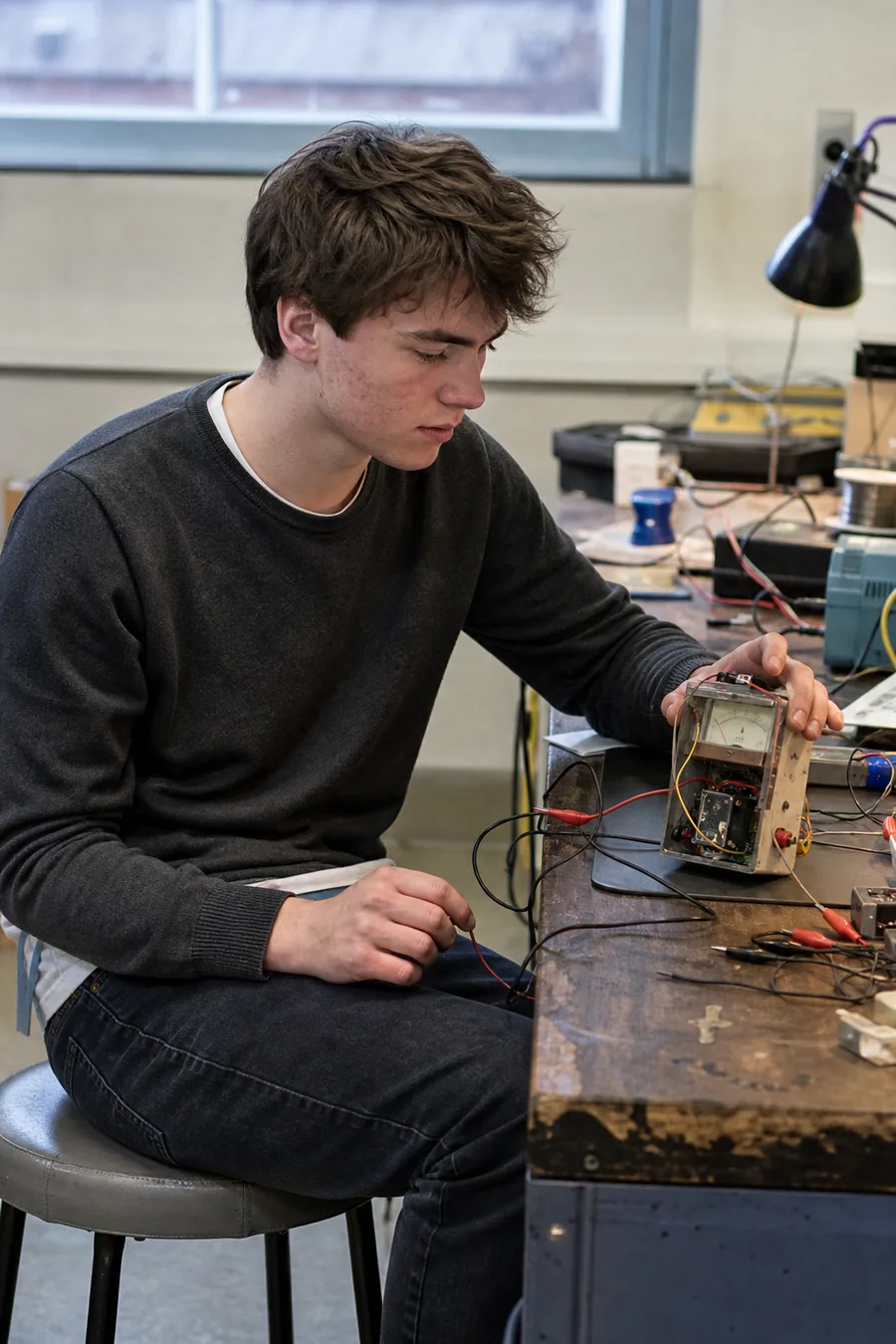
AI-generated representative image; it does not depict the client.
AT A GLANCE

The context behind the decisions.

Entry point
First-year undergraduate admission
Background
Student at a state sixth-form college in northern England
Academic direction
Physics, electronics and scientific instrumentation
Ordinary complication
Excellent examination performance, little formal leadership and a personal project that failed repeatedly
Financial consideration
Major cost difference between domestic and U.S. study
Support emphasis
Technical reflection, U.K.-U.S. application planning, interviews and cost-aware choice
Acceptances
University of Cambridge Natural Sciences; Imperial College London Physics; Massachusetts Institute of Technology
Other result
Rejected by California Institute of Technology
Final choice
Imperial College London
EXTENDED CASE ANALYSIS

The failed detector was the better result

G.S.’s failed detector became stronger evidence than a perfected project claim, while his final decision showed that direct academic structure and sustainable cost can outweigh the symbolic appeal of studying abroad.

THE STARTING READ

Excellent physics and an instrument that would not settle

G.S. liked instruments as much as theories. He repaired secondhand electronics and tried to build a low-cost detector for a school demonstration. The device produced unstable readings for months. He had strong examination results and participated in physics club, but he was not captain of a team and had no national organization attached to his project. His school could support a Cambridge application more easily than the additional testing, recommendations and financial forms required in the United States.

The family could contribute to university costs but could not treat a large international price difference as immaterial. G.S. still wanted to test whether the U.S. project-based environment suited him.

THE CENTRAL DIAGNOSIS

When a successful project description became less accurate

What the application already showed

  • Excellent physics and examination preparation
  • Sustained practical electronics work
  • Ability to reason through a failed design

What it did not yet answer

  • Did the detector work as the first description implied?
  • What had G.S. learned from unstable results?
  • Could the family justify the cost of U.S. study?
THE INTELLECTUAL CENTER

Noise, abandoning a design, and three different degrees

The questions below did not supply an admissions formula. They determined what evidence needed to be checked, which claims needed limits, and what the applicant still had to decide.

When is a noisy reading evidence rather than an embarrassment?

A noisy reading became evidence when G.S. treated instability as information about the circuit rather than an error to remove from the account.

When should a technical idea be abandoned?

Abandoning part of the original design became responsible when repeated testing showed that attachment to it was blocking progress.

Which degree structure fits the way G.S. wants to learn?

The right degree depended on whether G.S. wanted Natural Sciences breadth, direct physics, or wider project flexibility—and what each choice cost the family.

THE TURNING POINT

The detector improved only after G.S. stopped defending the original design.

For Cambridge, G.S. prepared for subject-focused interviews by explaining reasoning aloud, including when he did not know the next step. U.S. essays included collaboration, practical making and life beyond physics. His main technical response described the detector's failure and the moment he stopped treating every unstable reading as an error to hide.

The family built a cost model using official aid information, travel, health coverage, exchange rates and likely program length. Academic comparison covered laboratory access, course flexibility, teaching format and the ability to continue electronics. G.S. also visited Imperial and spoke with students about the daily experience of a highly focused urban program.

SELECTING EVIDENCE

The facts stayed the same. Their hierarchy changed.

Evidence was made more precise, attributable, and useful. The goal was not to enlarge the record, but to stop one title, institution, hardship, or outcome from carrying more meaning than it could support.

Earlier presentation

The project description implied stable performance.

Stronger presentation

Failed circuits and unstable readings were restored.

Earlier presentation

Success meant making the original design work.

Stronger presentation

Success included recognizing that a design choice was unsuitable.

Earlier presentation

U.S. study represented the more ambitious route.

Stronger presentation

The family evaluated whether its added cost produced the right educational value.

APPLICATION CONTEXT

A U.K. state-school application stretched across the Atlantic

G.S. believed technical applicants should present successful devices. He removed failed circuits from his notes and wrote a project description that implied the detector worked reliably. Restoring the actual sequence revealed better evidence: how he isolated sources of noise, asked for help and eventually concluded that part of the original design was unsuitable.

Cambridge, Imperial and MIT also represented different educational structures. Cambridge Natural Sciences offered breadth before specialization; Imperial provided direct physics in London; MIT combined institutional breadth with a distant and costly move. A meaningful choice required more than comparing physics reputations.

STUDENT OWNERSHIP

Independence remained visible in the work.

  • G.S. created the device, kept the failed evidence and wrote all applications. Guidance helped him explain physics to different audiences but did not repair the project or claim a result it had not achieved. Financial decisions remained with the family.
OUTCOME & DECISION

Choosing direct physics without apologizing for cost

G.S. was admitted to Cambridge, Imperial and MIT and denied by Caltech. MIT was a serious ambition, while Cambridge offered a distinctive tutorial and supervision model. He chose Imperial because direct physics, laboratory access, location and the substantially lower family cost outweighed the appeal of studying abroad. The decision was not an apology for declining the highest-ranked offer in the set.

WHAT CHANGED

  • Failed circuits and unstable readings returned to the project record.
  • The unsuitable design choice became a conclusion rather than an embarrassment.
  • Cambridge, Imperial, and MIT were compared as educational structures, not a physics ranking.
  • Total family cost became an explicit form of decision quality.

WHAT DID NOT CHANGE

  • The detector remained unreliable for much of its development.
  • G.S. still had little formal leadership.
  • MIT and Cambridge remained exceptional and serious alternatives.
  • The family could contribute, but a large international cost difference still mattered.
HOW THE FILE BECAME LEGIBLE

The reader’s understanding changed in stages.

This sequence describes what the revised evidence made easier to understand. It does not claim to reconstruct an admissions committee’s private deliberations.

Academic read

An excellent physics student with practical electronics interest and limited formal leadership.

First project claim

A detector description that implied more reliability than the evidence supported.

Failure restored

A student able to investigate noise, ask for help, and reject part of his own design.

Final comparison

A family choosing direct physics, laboratory access, location, and sustainable cost among exceptional options.

WHAT COULD HAVE WEAKENED THE CASE

The alternatives were plausible—and less useful.

Describe the detector as successful

A cleaner project claim would contradict months of unstable evidence.

Remove the failed circuits

The record would lose the reasoning that showed how G.S. learned.

Treat every unstable reading as noise to ignore

Evidence about the design itself would be discarded to protect the original idea.

Choose the most symbolically ambitious offer

Teaching structure, location, and a major cost difference would be treated as secondary.

DECISION DISCIPLINE

Each stage used a different test.

DecisionHow it was tested
How to describe failureShow the sequence of readings, tests, help, and the decision to reject part of the design.
How to compare programsSeparate breadth, direct physics, laboratory access, teaching format, and project flexibility.
How to model costInclude official aid, travel, health coverage, exchange rates, and likely program length.
How to make the final choiceChoose the structure and cost that fit the family without rewriting the declined offers as mistakes.

WHAT THIS CASE SUPPORTS

  • G.S. sustained an independent electronics project through repeated failure.
  • He could isolate problems, seek help, and abandon an unsuitable design element.
  • The family compared educational structures with full cost and location.

WHAT IT CANNOT PROVE

  • That the detector became a reliable scientific instrument.
  • That technical failure alone demonstrated readiness for every physics program.
  • That choosing the lower-cost route made the other offers inferior.
QUESTIONS FOR A SIMILAR APPLICANT

Questions to ask when the device still does not work

The profile shows how one applicant’s evidence and decisions were organized. It does not predict another person’s result or supply a story to copy.

  • Which failed reading did you initially want to hide?
  • What evidence told you that persistence had become attachment?
  • Who helped you see a problem your own model missed?
  • Do you want breadth before specialization or direct subject depth now?
  • What educational difference is large enough to justify the cost difference?
G.S.’s journey shows that a failed instrument can reveal disciplined thinking—and that declining an exceptional offer can be an equally disciplined decision. Technical failure can be stronger evidence than a polished result when the applicant understands it. G.S.'s choice also makes cost visible without treating it as a lesser form of reasoning. Exceptional offers can lead to different correct decisions for different families.
CONTINUE EXPLORING
Undergraduate AdmissionsAll 40 client journeysAll student results
YOUR NEXT STEP

Your application should still sound and feel like your own.

We will listen carefully and tell you whether we believe Letrado is the right fit. If another resource would serve you better, we will be honest about that too.

See If We Are a Fit