SMALL BY DESIGN Deep care. Honest fit. Relationships that last. Why we stay small →
Menu
Request a Consultation
← All Undergraduate Admissions journeys
ANONYMIZED CLIENT JOURNEY · U5

A.P.

Brazilian secondary-school student / Architecture and urban life / Strong visual habits, limited formal portfolio training

A.P. had years of visual observation but no formal portfolio training and a mathematics record that was strong without being flawless. Her preparation clarified different degree systems and built a portfolio around process rather than polish. Admitted to Cambridge, Berkeley and Columbia, she chose Berkeley for environmental design, flexibility and cost.

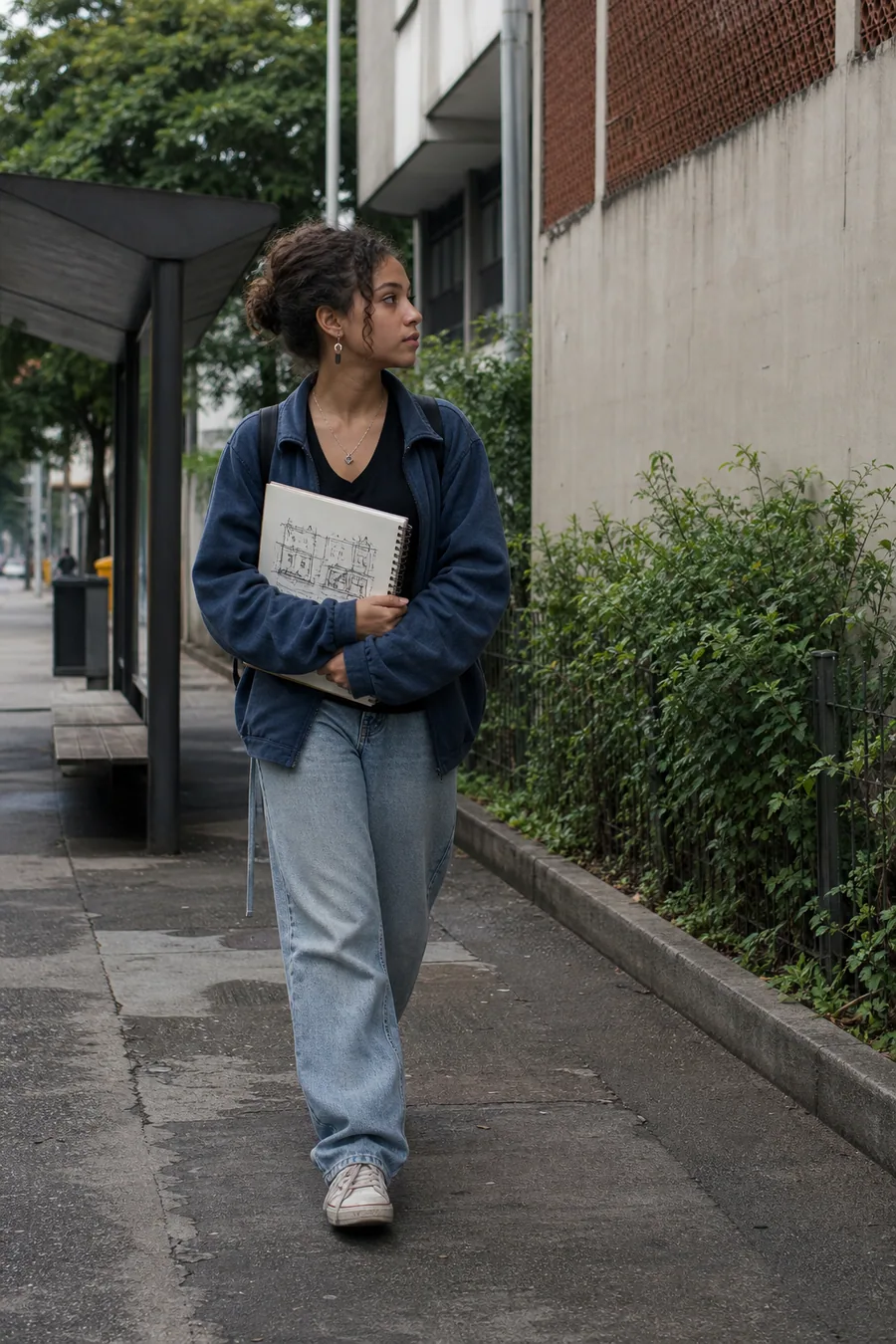
AI-generated representative image; it does not depict the client.
AT A GLANCE

The context behind the decisions.

Entry point
First-year undergraduate admission
Background
Student at a bilingual secondary school in São Paulo
Academic direction
Architecture, urban studies, art history and environmental design
Ordinary complication
Strong observational drawings, no major art awards and mathematics performance below the rest of the transcript
Application complexity
Different portfolio, testing and course expectations across the United Kingdom and United States
Support emphasis
Cross-system planning, portfolio process, academic context and affordability
Acceptances
University of Cambridge BA Architecture; University of California, Berkeley BA Architecture; Columbia University undergraduate architecture pathway
Other results
Rejected by MIT; waitlisted at Cornell University
Final choice
University of California, Berkeley
EXTENDED CASE ANALYSIS

Design begins where appearance stops being enough

A.P.’s architecture application became rigorous when polished images gave way to observation, process, error, human use, and a real comparison of different degree and professional pathways.

THE STARTING READ

A serious visual habit without formal portfolio training

A.P. photographed bus stops, apartment courtyards and the improvised shade structures used by street vendors. She sketched constantly but had never studied in a formal portfolio program. Her school record was strongest in literature, history and visual art; mathematics was respectable rather than exceptional, with one weaker term during a change in teachers. She wanted to study architecture but used the word broadly, moving between design, urban policy and social questions without understanding how different undergraduate programs organized those interests.

Her first school list mixed direct-entry British architecture degrees with broad U.S. liberal-arts programs. Deadlines, portfolio requirements and the role of standardized testing differed enough that a single application strategy would fail.

THE CENTRAL DIAGNOSIS

What finished drawings were hiding

What the application already showed

  • Sustained visual observation
  • Strong literature, history, and visual-art work
  • Interest in urban use and environmental design

What it did not yet answer

  • Did the portfolio reveal thinking or only visual polish?
  • Did A.P. want direct architecture training or broader study?
  • What did different routes imply for cost and professional progression?
THE INTELLECTUAL CENTER

Use, failed materials, and different paths into architecture

The questions below did not supply an admissions formula. They determined what evidence needed to be checked, which claims needed limits, and what the applicant still had to decide.

Who is a design working for at the time it is used?

A design was working for its user only if it responded to the time, climate, and behavior of the people occupying it—not simply if it looked elegant from the road.

What does an unfinished model reveal?

An unfinished model revealed A.P.'s thinking when a failed material choice forced a change in form and method.

How do academic structures change the path into architecture?

Academic structure changed the route into architecture through studio intensity, liberal-arts breadth, program length, and different forms of professional progression.

THE TURNING POINT

The bus shelter looked better from the road than it worked from the pavement.

The portfolio was rebuilt around three small investigations: shade and waiting, the boundaries between public and private space, and how people adapt buildings after design. Captions stated what A.P. had observed and where she was speculating. A short model-making sequence included a failed material choice and the adjustment it produced. Nothing was presented as a commissioned design or a tested community solution.

Her main written piece followed a bus shelter that looked elegant from the road but provided little shade at the time commuters actually used it. The essay connected visual attention with human use without claiming that A.P. could solve the city's transport system. Mathematics context was concise, and later improvement was allowed to speak for itself. Program research compared studio intensity, liberal-arts breadth, environmental design, professional progression and cost.

SELECTING EVIDENCE

The facts stayed the same. Their hierarchy changed.

Evidence was made more precise, attributable, and useful. The goal was not to enlarge the record, but to stop one title, institution, hardship, or outcome from carrying more meaning than it could support.

Earlier presentation

The portfolio prioritized finished facade drawings.

Stronger presentation

Three investigations showed questions, process, speculation, and revision.

Earlier presentation

Failed materials were removed.

Stronger presentation

A model sequence showed how an unsuitable choice changed the work.

Earlier presentation

Architecture programs appeared interchangeable.

Stronger presentation

Direct entry, breadth, studio intensity, and progression were compared.

APPLICATION CONTEXT

One student, two admissions systems, several professional routes

A.P. believed a portfolio had to look finished. She selected polished facade drawings and removed pages that showed measurement errors, abandoned materials and questions about how a space was used. The result demonstrated skill but little thought. Restoring process required confidence that imperfect work could be more revealing than an image designed to impress.

The family also needed a financial comparison that accounted for program length, travel, exchange rates and the uncertainty of professional qualification across countries. A.P. initially treated those questions as a distraction from creative fit. They became essential once she understood that architecture education can lead through different academic and licensing pathways.

STUDENT OWNERSHIP

Independence remained visible in the work.

  • A.P. created and selected the visual work, wrote all captions and retained ownership of every design decision. Feedback addressed sequence, legibility and unsupported claims. No one redrew an image, presented ordinary observation as formal field research or communicated with a university for her.
OUTCOME & DECISION

Choosing environmental design, flexibility, and sustainable cost

A.P. was admitted to Cambridge, Berkeley and Columbia, waitlisted at Cornell and denied by MIT. Cambridge offered a highly focused architecture route; Columbia allowed broader study in New York. She chose Berkeley because its environmental-design context, academic flexibility and overall family cost created the strongest combination. The decision did not assume the most specialized or famous option was automatically right.

WHAT CHANGED

  • Portfolio sequence shifted from polished facades to questions, process, and revision.
  • Failed material choices remained visible.
  • Captions distinguished observation from speculation.
  • Degree structure and professional progression became as important as institutional name.

WHAT DID NOT CHANGE

  • A.P. had no major art award or formal portfolio program.
  • The mathematics record remained respectable but below the rest of the transcript.
  • Her observations were not commissioned or tested public designs.
  • The British and American routes remained genuinely different rather than directly rankable.
HOW THE FILE BECAME LEGIBLE

The reader’s understanding changed in stages.

This sequence describes what the revised evidence made easier to understand. It does not claim to reconstruct an admissions committee’s private deliberations.

Visual record

A strong observer with years of sketches but no formal portfolio distinction.

Process restored

A.P. could show error, material limits, and the decisions behind the image.

Use becomes central

Her interest moved from how a space looked toward whom it served and when.

Degree choice

The family compared studio, breadth, progression, duration, and cost before choosing a route.

WHAT COULD HAVE WEAKENED THE CASE

The alternatives were plausible—and less useful.

Submit only polished facade studies

Technical finish would conceal the observation and revision that made A.P.'s work distinctive.

Remove every failed model

The portfolio would show outcomes without the design decisions that produced them.

Treat all architecture programs as equivalent

A.P. could choose a famous name without understanding studio intensity or later professional steps.

Postpone cost and qualification questions

Creative fit could be separated from the total pathway the family would need to fund.

DECISION DISCIPLINE

Each stage used a different test.

DecisionHow it was tested
How to organize the portfolioBuild around observed questions and revisions rather than a gallery of best-looking work.
How to state design claimsLabel observation, speculation, model testing, and untested ideas separately.
How to compare degree routesMap studio, breadth, environmental design, duration, and professional progression.
How to choose among offersCombine the way A.P. wanted to learn with the full cost and future pathway.

WHAT THIS CASE SUPPORTS

  • A.P. sustained close observation of urban space and human use.
  • Her visual work included genuine process, failed choices, and revision.
  • She could compare materially different degree and cost structures.

WHAT IT CANNOT PROVE

  • That her bus-shelter observation was a tested design solution.
  • That she had professional architecture experience.
  • That one undergraduate route automatically supplied professional qualification everywhere.
QUESTIONS FOR A SIMILAR APPLICANT

Questions to ask before calling a portfolio finished

The profile shows how one applicant’s evidence and decisions were organized. It does not predict another person’s result or supply a story to copy.

  • At what hour and under what conditions does the design need to work?
  • Which failed model changed the question rather than merely the material?
  • What part of your caption is observed fact, and what part is interpretation?
  • Do you want direct studio training now or room to study the city from several disciplines?
  • What later training does each undergraduate route still require?
A.P.’s strongest portfolio did not look the most finished. It showed the moment appearance stopped being enough and use became the harder design question. Creative preparation becomes stronger when process, error and observation remain visible. A.P.'s cross-system application also shows why degree structure and professional pathway matter as much as an institution's name. Her final choice emerged from comparing how she wanted to learn, not only what she wanted to study.
CONTINUE EXPLORING
Undergraduate AdmissionsAll 40 client journeysAll student results
YOUR NEXT STEP

Your application should still sound and feel like your own.

We will listen carefully and tell you whether we believe Letrado is the right fit. If another resource would serve you better, we will be honest about that too.

See If We Are a Fit