SMALL BY DESIGN Deep care. Honest fit. Relationships that last. Why we stay small →
Menu
Request a Consultation
← All Undergraduate Admissions journeys
ANONYMIZED CLIENT JOURNEY · U6

H.J.

Seoul international-school student / Literature, statistics and translation / Resisting an artificial “humanities versus data” choice

H.J. combined literature, translation and statistics, but early drafts sounded like a student performing the role of a literary critic. Her preparation restored a natural voice and separated U.K. subject admission from U.S. exploration. Admitted to Oxford, Yale and Columbia, she chose Yale for depth with room to test both interests.

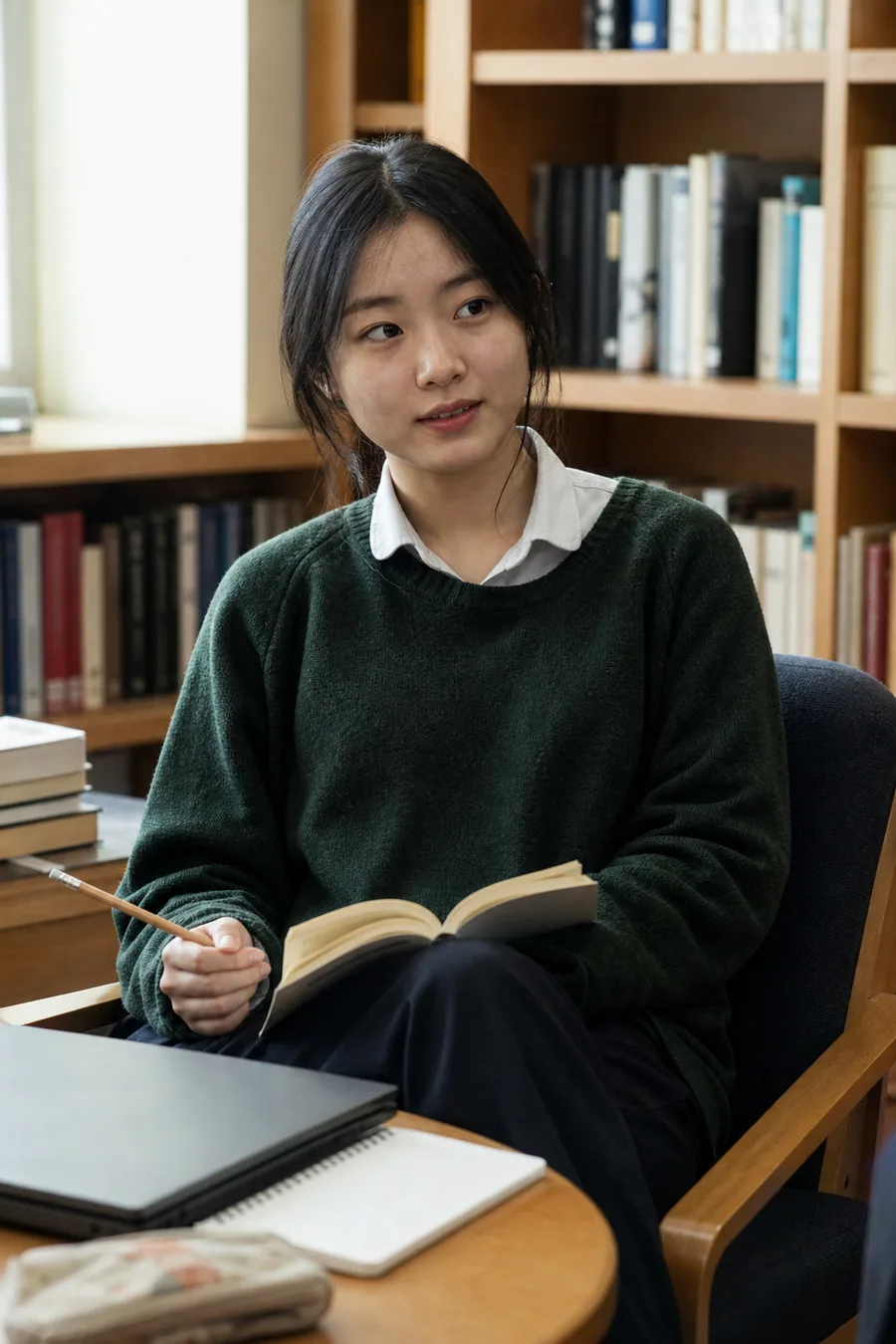
AI-generated representative image; it does not depict the client.
AT A GLANCE

The context behind the decisions.

Entry point
First-year undergraduate admission
Background
Korean student at an international school in Seoul
Academic direction
English literature, statistics, translation and digital humanities
Ordinary complication
Broad academic interests, a modest activity list and writing that initially tried too hard to sound literary
Family consideration
Parents wanted a clearly employable quantitative major; the student did not want to abandon close reading and language
Support emphasis
Intellectual coherence, voice, course research and family communication
Acceptances
University of Oxford English Language and Literature; Yale University; Columbia University
Other results
Rejected by Stanford University; waitlisted at University of Pennsylvania
Final choice
Yale University
EXTENDED CASE ANALYSIS

Two ways of asking better questions

H.J. did not need to choose between literature and statistics or invent a digital-humanities project. She needed to show the distinct questions each discipline allowed her to ask.

THE STARTING READ

Literature, statistics, and a project that did not exist

H.J. enjoyed translating contemporary poems for friends and analyzing how word choice changed between subtitles and spoken dialogue. She also performed strongly in statistics and liked using simple text analysis to test impressions about a novel. Her activities were steady but not spectacular: literary magazine, peer tutoring, a statistics club and translation work for school events. The first application tried to make them look like one sophisticated digital-humanities project that did not actually exist.

At home, discussion of university quickly became discussion of employment. Her parents interpreted literature as a personal interest and statistics as the responsible degree. H.J. reacted by defending the humanities in grand terms instead of investigating programs that allowed both modes of thinking.

THE CENTRAL DIAGNOSIS

When sophisticated prose stopped sounding like H.J.

What the application already showed

  • Strong close reading and translation habits
  • Quantitative ability in statistics
  • Sustained literary-magazine and tutoring work

What it did not yet answer

  • Could literature and statistics coexist without a fictional project?
  • Would H.J.’s natural voice survive editing?
  • How would Oxford’s subject-specific structure differ from U.S. exploration?
THE INTELLECTUAL CENTER

Translation, evidence, and how early to specialize

The questions below did not supply an admissions formula. They determined what evidence needed to be checked, which claims needed limits, and what the applicant still had to decide.

What is lost when a translation is literally correct?

Literal correctness became insufficient when an actor could not deliver H.J.'s subtitle naturally, forcing a choice among fidelity, rhythm, and audience.

When can data test a reading without replacing it?

Data could test a reading when it sharpened an interpretive question without pretending that word counts replaced literary judgment.

How much academic commitment is appropriate before enrollment?

The right amount of commitment differed by system: Oxford required a defined subject case, while U.S. programs allowed H.J. to continue testing both interests.

THE TURNING POINT

The most literal subtitle was the one the actor could not say.

For Oxford, H.J. developed a focused academic statement and selected written work that showed close reading rather than breadth for its own sake. For U.S. applications, her personal essay examined a subtitle disagreement during a school performance. She had chosen the most literal translation, only to discover that the actor could not deliver it naturally. The revision showed her balancing fidelity, rhythm and audience.

Supplemental research identified concrete ways to connect literature and quantitative work without promising a double major before enrollment. She compared distribution requirements, departmental access, digital-humanities resources and the freedom to change direction. Family discussions used sample curricula and career pathways rather than abstract claims about whether a subject was practical.

SELECTING EVIDENCE

The facts stayed the same. Their hierarchy changed.

Evidence was made more precise, attributable, and useful. The goal was not to enlarge the record, but to stop one title, institution, hardship, or outcome from carrying more meaning than it could support.

Earlier presentation

Activities were packaged as one digital-humanities project.

Stronger presentation

Separate interests were connected through habits and questions.

Earlier presentation

Prose used elaborate metaphors and quotations.

Stronger presentation

Reading drafts aloud removed language H.J. would never naturally use.

Earlier presentation

One application identity stretched across systems.

Stronger presentation

Oxford and U.S. materials followed their distinct admissions logic.

APPLICATION CONTEXT

Parallel applications rather than parallel identities

H.J.'s prose was polished enough to hide her. She used elaborate metaphors and quotations because she thought an English applicant should sound like a published critic. When asked to read drafts aloud, she laughed at sentences she would never say. Removing them did not make the writing less intelligent; it made room for her dry humor, uncertainty and specific habits as a reader.

The school list also crossed incompatible admissions logics. Oxford required clear preparation for a defined subject and written work; U.S. institutions allowed broader exploration and evaluated a more extensive extracurricular record. H.J. needed parallel plans without inventing separate identities for each system.

STUDENT OWNERSHIP

Independence remained visible in the work.

  • H.J. wrote and translated every piece herself. Feedback addressed structure and whether the English sounded like her, not whether it sounded maximally ornate. She did not create a last-minute research project to justify the connection between literature and statistics.
OUTCOME & DECISION

Choosing depth with room to keep testing both interests

H.J. was admitted to Oxford, Yale and Columbia, waitlisted at Penn and denied by Stanford. Oxford offered the most concentrated literary training; Columbia offered a strong core in New York. She chose Yale because she wanted demanding humanities work alongside genuine freedom to continue statistics before committing to a fixed combination. Her parents supported the choice after reviewing the curriculum and financial package.

WHAT CHANGED

  • The fictional interdisciplinary project disappeared.
  • Literature and statistics remained separate but intellectually compatible habits.
  • Reading drafts aloud removed language H.J. would never say.
  • Oxford and U.S. materials followed their actual admissions purposes.

WHAT DID NOT CHANGE

  • Her activity record remained steady rather than spectacular.
  • No formal digital-humanities research was claimed.
  • Literature and statistics continued to ask different kinds of questions.
  • Her parents' concern about employment remained legitimate enough to examine directly.
HOW THE FILE BECAME LEGIBLE

The reader’s understanding changed in stages.

This sequence describes what the revised evidence made easier to understand. It does not claim to reconstruct an admissions committee’s private deliberations.

Activity read

A capable student with translation, literature, tutoring, and statistics but no obvious centerpiece.

First narrative

An artificial digital-humanities identity expressed in prose more ornate than personal.

Translation decision

A reader and translator balancing fidelity, rhythm, evidence, and audience.

Program comparison

A student choosing whether to specialize now or preserve room for both modes of inquiry.

WHAT COULD HAVE WEAKENED THE CASE

The alternatives were plausible—and less useful.

Keep the digital-humanities project

The application would gain tidy coherence by claiming work H.J. had not actually done.

Write like a published critic

Sophistication would come at the cost of voice, humor, and believable authorship.

Choose statistics only for employability

A real literary interest would be removed before the program required that decision.

Use the same academic case everywhere

Oxford's subject focus and U.S. holistic review would both receive mismatched evidence.

DECISION DISCIPLINE

Each stage used a different test.

DecisionHow it was tested
How to connect the interestsShow distinct habits and moments of overlap without claiming a completed interdisciplinary project.
How to edit the voiceRead drafts aloud and remove language that H.J. would not naturally use.
How to prepare across systemsBuild focused subject evidence for Oxford and broader personal evidence for U.S. applications.
How to make the final choiceCompare literary depth, quantitative freedom, requirements, and financial terms.

WHAT THIS CASE SUPPORTS

  • H.J. had sustained interests and preparation in both literature and statistics.
  • She could make and revise translation choices for a real audience.
  • She understood that British and American applications required different evidence.

WHAT IT CANNOT PROVE

  • That H.J. had completed a digital-humanities project.
  • That literature and statistics were one discipline or required a double major.
  • That one subtitle choice established professional translation expertise.
QUESTIONS FOR A SIMILAR APPLICANT

Questions for a student being asked to choose too soon

The profile shows how one applicant’s evidence and decisions were organized. It does not predict another person’s result or supply a story to copy.

  • Which sentence sounds intelligent on paper but unlike anything you would say?
  • When did a technically faithful translation fail its audience?
  • What can a quantitative pattern test without deciding the interpretation?
  • Which program asks you to specialize now, and which lets the choice remain open?
  • Can your family see the actual curriculum rather than only a major label?
H.J.’s profile became coherent when it stopped arguing that literature and statistics were secretly the same and showed why she was not ready to surrender either. Coherence does not require reducing a student to one subject. H.J.'s application became credible when literature and statistics were shown as different habits of inquiry rather than forced into a fictional project. Program structure resolved a family disagreement more effectively than slogans about passion or employability.
CONTINUE EXPLORING
Undergraduate AdmissionsAll 40 client journeysAll student results
YOUR NEXT STEP

Your application should still sound and feel like your own.

We will listen carefully and tell you whether we believe Letrado is the right fit. If another resource would serve you better, we will be honest about that too.

See If We Are a Fit