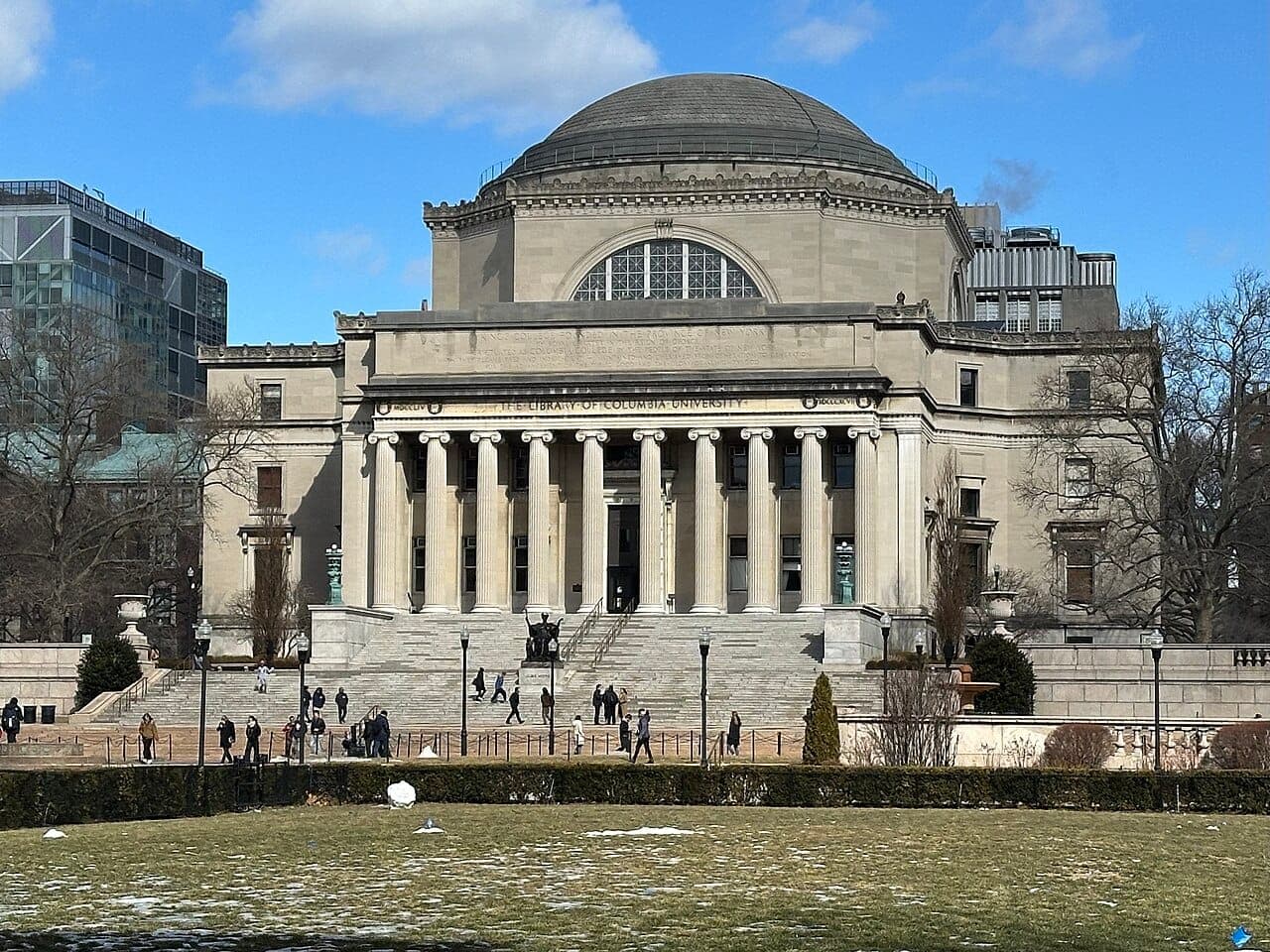
Columbia University
New York, New York · Private
We separate what the school publishes from what it means for an applicant. When the school does not reveal a rule or weight, the guide says so.
Columbia wants an academically prepared student whose choice of College or Engineering makes sense. New York and the Core matter only when the application shows how they would change the student's weekly reading, discussion, research, or making.
Columbia's fit question begins with an undergraduate school, not the university name.
Columbia College and Columbia Engineering admit into different curricular structures. For College applicants, the Core creates sustained common reading and discussion; for Engineering applicants, the technical foundation and intended field change what readiness and fit mean. A generic Columbia essay misses the first decision the institution asks the student to make.
Official Columbia materials describe academic preparation as the primary factor in holistic review. The rest of the file gives that preparation direction and context: what the applicant reads or makes, how they use an urban environment, what communities they enter, and whether their proposed school matches their record.
Columbia does not publish a granular reader-rating system. The appropriate analysis is therefore functional rather than speculative: identify what each component helps the committee learn and whether the same intellectual case survives the transition from transcript to lists, essays, recommendations, and school-specific choice.

The committee needs to see preparation, curricular fit, and a credible way of participating in density.
A Columbia application is strongest when the applicant's school choice changes the evidence selected. College may emphasize appetite for common texts and cross-disciplinary exchange; Engineering requires a technically credible foundation and a reason to value its own shared curriculum and New York setting.
New York is analytically useful only when attached to action. The city should alter the proposed academic life through archives, laboratories, hospitals, public institutions, artistic communities, industry, or civic work—not function as a skyline in prose.
School-specific read
- What the school says it does
- Applicants select Columbia College or Columbia Engineering, each with distinct preparation and curriculum.
- What this means for the application
- The academic argument must be written for the chosen school; resources and goals should not be interchangeable across the two.
Academic preparation
- What the school says it does
- Official counselor materials describe academic preparation as the primary factor in Columbia's holistic review.
- What this means for the application
- Course rigor and performance should make the proposed pathway credible before supplements attempt to establish fit.
Whole-file context
- What the school says it does
- Columbia reviews achievements within school and personal context and considers writing, recommendations, activities, and the selected program together.
- What this means for the application
- Lists and essays should add interpretation, not repeat the transcript or substitute cultural consumption for intellectual response.
Comparative decision
- What the school says it does
- The final decision occurs within a highly qualified pool and the needs of each undergraduate school.
- What this means for the application
- The file should make a specific school-level contribution easy to advocate without pretending fit creates entitlement.
Each part answers a different question. Together, they still need to describe one person.
The middle column stays close to what the school publishes. The last column explains what that means without pretending there is a secret formula.
Preparation
- What this part can prove
- Columbia identifies secondary-school performance and acquired skills as central indicators of readiness.
- What the reader is trying to learn
- The transcript should support the methods required by the chosen school, while recommendations show how that preparation appears in live intellectual work.
School choice
- What this part can prove
- College and Engineering have different curricula, requirements, and educational identities.
- What the reader is trying to learn
- A student undecided between them should resolve the learning-model question before drafting; applying to a label rather than a structure produces generic reasoning.
Intellectual inputs
- What this part can prove
- Columbia's application asks about texts, resources, and media that have contributed to the applicant's intellectual development.
- What the reader is trying to learn
- The list is not a sophistication contest. Its value comes from the pattern of attention it reveals and whether other responses show actual engagement.
Community and context
- What this part can prove
- Holistic review considers activities, responsibilities, recommendations, and the environment producing the record.
- What the reader is trying to learn
- Readers need to see how the student enters shared work, handles difference, and uses opportunity rather than merely consuming it.
Urban academic fit
- What this part can prove
- Columbia presents New York as integrated into academic and student life.
- What the reader is trying to learn
- A persuasive city argument names a problem, field, institution, or practice that changes the student's weekly learning—not a general attraction to energy and diversity.
Use the data to ask better questions.
Past-class ranges describe prior cohorts. They are not minimums, targets, or guarantees. We call a figure a minimum only when the institution publishes it as a requirement.
Class of 2029 applications
Columbia admitted 2,946 students and enrolled 1,806. The number demonstrates scarcity, not an individual probability model.
Columbia Class of 2029 profile ↗Top tenth where rank was reported
Among entering students whose schools reported rank, ninety-four percent were in the top tenth. This is cohort context, not an admission cutoff.
Columbia Class of 2029 profile ↗Distinct undergraduate pathways
Columbia College and Columbia Engineering share a university but ask different curricular and preparation questions.
Columbia undergraduate admissions ↗Middle 50% SAT among submitters
The ACT range was 34–36. Columbia remains test-optional for 2026–27 and will require testing for Fall 2028 entry, with hardship waivers.
Columbia testing update ↗Follow the reasoning, not just the final sentence.
The detailed scenario below is illustrative. It shows the starting facts, the weak version, the stronger evidence, and the question a careful reader would ask next.
New York became part of the work instead of the scenery.
An illustrative applicant interested in public memory filled the Columbia draft with the Core, museums, internships, and New York landmarks. The resources were real, but the essay could have been written by almost anyone who liked the city.
Columbia's Core and New York's unmatched cultural resources will let me explore history from every angle.
The student begins with a question already present in her school research: why two neighborhoods remember the same redevelopment project differently. She explains how a Core discussion about civic duty could sharpen the question, identifies an oral-history collection she would learn to use, and describes the kind of seminar paper that could connect the two. Her intellectual list supports the interest with local planning minutes, a translated podcast, and one novel—not a catalogue of famous works. New York now changes the method and weekly work rather than decorating the conclusion.
- The academic question existed before the university name entered the essay.
- Specific resources have a clear job in the proposed work.
- The list, essay, and prior project describe one pattern of attention.
A second way the same kind of application can weaken.
Make New York change the work
I will use the Core, museums, internships, and New York's diversity.
A student interested in public memory connects a Core debate about civic duty to oral histories in a city archive, then uses that evidence in a seminar paper.

Read every claim from the other side of the desk.
A reader should be able to answer four simple questions: What happened? What did the student decide? What changed? Who or what else backs it up?
Every document has a different job.
Repeating the same story can sound polished without adding proof. A stronger file uses each part to answer a different question and lets other people back up the claims that matter.
Academic record
- What the reader needs from it
- Show readiness across subjects and the methods needed in the chosen undergraduate school.
- What weakens it
- Excellent grades presented without any connection to the selected pathway.
- What stronger evidence looks like
- Rigor, performance, and intellectual progression aligned with the College or Engineering curriculum.
Intellectual lists
- What the reader needs from it
- Show what the student actually reads, watches, and listens to—and the questions that hold their attention.
- What weakens it
- Famous books, publications, and performances chosen mainly to look impressive.
- What stronger evidence looks like
- A real mix that feels like this student, with its influence visible in later questions, work, or choices.
Columbia supplements
- What the reader needs from it
- Explain why the College or Engineering fits and how the student would use its structure each week.
- What weakens it
- A tour of famous Core texts, New York landmarks, and program names.
- What stronger evidence looks like
- A few well-chosen resources tied to questions the student already pursues and a believable weekly academic life.
Recommendations
- What the reader needs from it
- Show how the student learns, discusses ideas, responds to feedback, and affects the classroom.
- What weakens it
- General praise with no classroom example.
- What stronger evidence looks like
- A teacher describes a real moment of analysis, disagreement, revision, collaboration, or work beyond the assignment.
Activities and context
- What the reader needs from it
- Show time use, contribution, urban or local participation, responsibilities, and the environments shaping the student.
- What weakens it
- Treating recognizable New York institutions as evidence by association.
- What stronger evidence looks like
- Specific ownership and consequence, including ordinary work or family commitments when they explain the record.
Make every important claim easy to check.
These questions turn the school's process into a practical checklist for this applicant.
School-specific preparation
Connect courses, methods, projects, and recommendations to the chosen undergraduate school and the way the student wants to learn.
Intellectual inputs with response
Lists of books, media, and cultural material are useful only when the rest of the application shows what the applicant noticed, questioned, or changed because of them.
Urban participation
Show how the student already enters complex communities, handles independence, and uses a city without turning opportunity into consumption.
Two questions should survive the whole application.
A persuasive case still needs the student's own voice and a believable picture of the daily academic life they are choosing.
Would this still sound like the student in a real conversation?
Columbia's list and short responses reward specificity. Name the books, media, communities, and questions that genuinely shape the applicant rather than assembling an impressive cultural inventory.
Would the student choose the daily reality—not only the name?
Connect the Core, chosen department, campus communities, and New York opportunities into one plausible weekly life.
Common strategic misreads.
- Writing one generic case for College and Engineering
- Treating the Core as a prestige signal
- Using New York as scenery
- Assuming domestic and foreign-citizen aid review follows the same policy
Decisions the applicant should be able to defend.
- Which undergraduate school fits the student's preparation and goals?
- Would the student value sustained common intellectual work through the Core?
- How would New York change the student's weekly academic life?
- Has the family checked the aid policy that applies to its status?
Read the rule where the institution publishes it.
These sources support the analysis above and remain the authority for application requirements, assessment, costs, aid, and deadlines.
Columbia undergraduate admissions
Current pathways, requirements, policies, and deadlines.
Open official source ↗Columbia affordability
Current financial-aid guidance and status distinctions.
Open official source ↗Core Curriculum viewbook
Official explanation of the Core and undergraduate experience.
Open official source ↗This is Letrado's educational analysis, not an admissions prediction or institutional endorsement. The institution's own instructions control the live application.
Build a Columbia University strategy around the person—not the name.
We will listen carefully and tell you whether we believe Letrado is the right fit. If another resource would serve you better, we will be honest about that too.
See If We Are a Fit
Representative image
Turn the published rules into a strong application.
The Core is an operating model, not a keyword
For College applicants, the relevant question is whether sustained common reading and argument sound energizing enough to shape several semesters. Quoting the Core without demonstrating this disposition makes the fit claim thinner, not stronger.
Urban access raises the burden of choice
A city rich in institutions can make an application look busy. Columbia fit becomes clearer when the student shows restraint: which opportunities matter, why those ones, and what work they are already prepared to do within them.
Lists require interpretation across the file
Because Columbia asks for compact intellectual lists, admissions folklore overweights individual titles. The better read looks for a pattern and then checks whether essays, courses, and activities confirm that pattern.