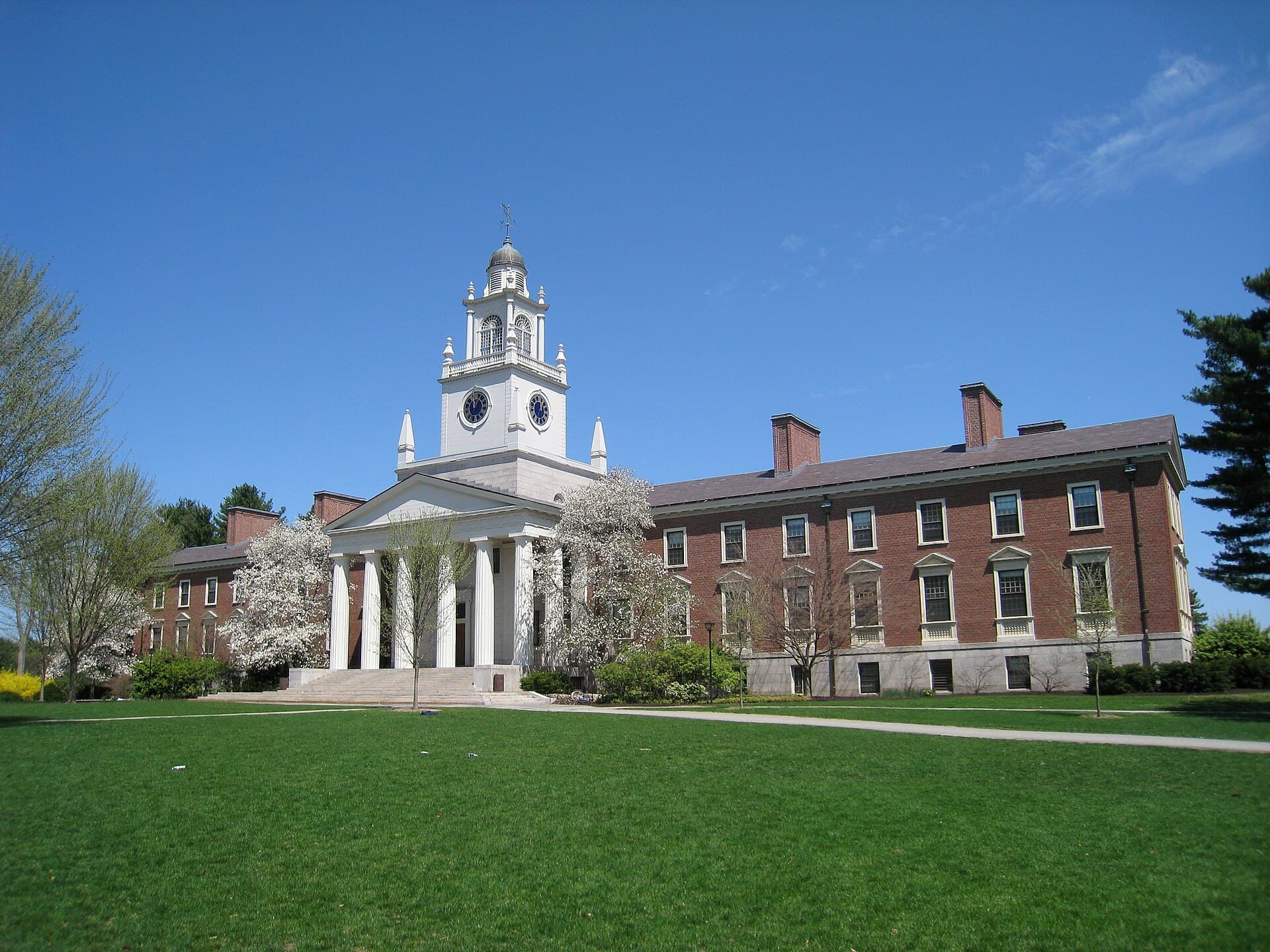
Phillips Exeter Academy
Exeter, New Hampshire · Boarding and day school
We separate what the school publishes from what it means for an applicant. When the school does not reveal a rule or weight, the guide says so.
Exeter is not looking for a miniature college applicant. The useful evidence is age-appropriate: how the student learns at a table, responds when work is hard, contributes to shared life, and asks for help.
Exeter is selecting for a way of learning, not a precocious college persona.
The Harkness table is more than a physical arrangement. It asks students to prepare independently, explain ideas, listen for what they may have missed, and move a discussion forward without treating every exchange as a performance.
The application therefore needs age-appropriate evidence of academic readiness and community behavior. Testing and grades can establish preparation, but teacher observations, student writing, the interview, and the family's account often reveal whether a young person can thrive in a demanding residential environment.
Exeter states that admission is need-blind and that it meets demonstrated need. That policy expands access; it does not remove the family's obligation to understand how the school calculates need or what expenses sit outside the award.

The committee is assessing the student, the learner, and the future community member at the same time.
A strong file makes intellectual energy visible without adult overproduction. It also shows how the student behaves when confused, disagrees respectfully, uses feedback, and participates in communities larger than a résumé.
Residential fit is practical. Independence, help-seeking, routines, friendships, conflict, distance from home, and willingness to contribute to dorm and campus life deserve the same seriousness as course catalog excitement.
Academic and school record
- What the school says it does
- Exeter reviews school records, recommendations, testing where required, and the educational context of the applicant.
- What this means for the application
- Establish current readiness and learning behavior without turning childhood into an admissions optimization project.
Student and family materials
- What the school says it does
- Applicant writing and parent information add voice, development, interests, and family context.
- What this means for the application
- The two perspectives should complement rather than imitate each other; the student's language must remain recognizably their own.
Conversation and synthesis
- What the school says it does
- The interview supports mutual assessment before the committee reaches a whole-file decision.
- What this means for the application
- Prepare for natural conversation and real questions, not a memorized sales pitch.
Each part answers a different question. Together, they still need to describe one person.
The middle column stays close to what the school publishes. The last column explains what that means without pretending there is a secret formula.
Learning readiness
- What this part can prove
- The record establishes whether the student is prepared for Exeter's pace and range.
- What the reader is trying to learn
- Readiness includes habits, curiosity, and response to challenge—not only acceleration or flawless grades.
Harkness participation
- What this part can prove
- Exeter centers discussion-based learning across the academic experience.
- What the reader is trying to learn
- Look for listening, explanation, revision, question-asking, and the ability to improve a group conversation.
Residential maturity
- What this part can prove
- Boarding students live within a structured but increasingly independent community.
- What the reader is trying to learn
- The relevant evidence is practical: self-management, help-seeking, relationships, recovery, and care for shared life.
Authentic voice
- What this part can prove
- Student-authored materials help the school know the child beyond adult reports.
- What the reader is trying to learn
- Imperfection can be informative. Adult vocabulary and engineered themes often obscure the person the school is trying to meet.
Use the data to ask better questions.
Past-class ranges describe prior cohorts. They are not minimums, targets, or guarantees. We call a figure a minimum only when the institution publishes it as a requirement.
Harkness table tradition
Small-table discussion makes preparation, listening, and contribution visible every day rather than reserving participation for occasional seminars.
Exeter on Harkness ↗Admission policy
Ability to pay is not considered in admission, and the school states that it meets demonstrated need for admitted students.
Exeter financial aid ↗Two lived contexts
Fit analysis should distinguish residential independence from the routines and access of a day student.
Exeter admissions ↗Applicants for 2025–26
Exeter reported 337 new students from forty countries. The scale makes authentic classroom and community fit more useful than a polished adult brand.
Exeter school update ↗2027 admission free-attendance threshold
Qualifying families must live and work in the U.S., receive W-2 income only, and have assets consistent with income. Final eligibility follows the complete aid application.
Exeter financial-aid calculator ↗Follow the reasoning, not just the final sentence.
The detailed scenario below is illustrative. It shows the starting facts, the weak version, the stronger evidence, and the question a careful reader would ask next.
Quiet participation still moved the discussion.
An illustrative fourteen-year-old had strong grades but rarely spoke first. The first application framed this as a confidence problem and claimed that Harkness would help her find her voice. That language missed what teachers already saw.
I love debate and look forward to sharing my ideas around the Harkness table.
During a literature discussion, two classmates disagreed about whether a character's decision was brave or reckless. The student listened, found a sentence neither had used, and asked what evidence would change each person's mind. She then explained that the passage had changed her own view. Her teacher can describe this scene. In the interview, she gives a practical answer about boarding: after a hard week she may become quiet, so she would speak with her adviser before missed sleep or work became a larger problem. The answer does not pretend she will never feel homesick.
- She listens closely and helps other students think.
- She can revise her own view.
- Her idea of independence includes using support.
A second way the same kind of application can weaken.
Test an ordinary Tuesday
I am independent and ready to board.
After rehearsal I still have homework, a dorm disagreement, and homesickness. I know when to ask my adviser for help and how I reset the next day.

The school is choosing a student, not a finished résumé.
Natural voice, learning habits, relationships, and readiness for daily school life matter more than adult-perfect language.
Every document has a different job.
Repeating the same story can sound polished without adding proof. A stronger file uses each part to answer a different question and lets other people back up the claims that matter.
School record and graded work
- What the reader needs from it
- Show readiness, classroom habits, development, and the educational context appropriate to the entry grade.
- What weakens it
- Adult-polished materials or testing treated as the child's entire academic identity.
- What stronger evidence looks like
- Authentic schoolwork, teacher context, age-appropriate strengths, and honest evidence of how the student learns.
Student writing
- What the reader needs from it
- Make interests, reflection, voice, relationships, and growing independence visible.
- What weakens it
- A miniature college essay written in adult language.
- What stronger evidence looks like
- Concrete, age-appropriate detail and a student whose humor, uncertainty, and thought remain recognizable.
Parent statement
- What the reader needs from it
- Add family history, growth, support needs, and context unavailable to the student or school.
- What weakens it
- Repeating the student's accomplishments or directing the committee toward a predetermined verdict.
- What stronger evidence looks like
- A candid complementary account of development, environment, practical needs, and the child's emerging independence.
Recommendations
- What the reader needs from it
- Show classroom contribution, learning behavior, relationships, response to feedback, and readiness for the environment.
- What weakens it
- Generic praise from teachers who cannot describe specific moments.
- What stronger evidence looks like
- Examples of curiosity, collaboration, setbacks, help-seeking, kindness, and change across the school year.
Interview
- What the reader needs from it
- Allow mutual assessment of personality, curiosity, communication, and residential or community fit.
- What weakens it
- A rehearsed adult performance optimized for prestige.
- What stronger evidence looks like
- Natural conversation, specific interests, honest questions, and age-appropriate self-awareness.
Make every important claim easy to check.
These questions turn the school's process into a practical checklist for this applicant.
Discussion-ready curiosity
Use classroom examples, teacher evidence, and the interview to show how the student asks, listens, and builds on another person's idea.
Age-appropriate independence
Show ordinary habits—organization, responsibility, recovery from difficulty, friendship, and willingness to seek help—without turning the child into an adult résumé.
Community contribution
Activities and interests should help a reader imagine the student joining dorm, class, team, club, and shared life.
Questions to settle before polishing the application.
The program-specific questions test this exact option. The second set tests whether the wider degree plan still makes sense.
Questions specific to Phillips Exeter Academy.
- Understand grade-entry options and current application components
- Prepare the student for a natural, age-appropriate interview
- Use school and teacher evidence to show learning habits
- Evaluate boarding, travel, aid, and pastoral fit together
Questions that remain true across the category.
- Would the student flourish in the school's actual weekly rhythm?
- What academic, residential, and pastoral support would the transition require?
- Can the family explain why this environment fits this child?
- Is the total financial and travel commitment sustainable?
Common strategic misreads.
- Treating Harkness as public speaking
- Adult-written student materials
- Ignoring boarding transition and support
- Using testing rules for the wrong entry grade
Decisions the applicant should be able to defend.
- Does the student learn by listening and contributing in discussion?
- What support would make boarding successful?
- Can the application remain recognizably age-appropriate?
- Would the family choose the daily environment, not only the outcome?
Read the rule where the institution publishes it.
These sources support the analysis above and remain the authority for application requirements, assessment, costs, aid, and deadlines.
Exeter application process
Current steps, interview, testing, documents, and dates.
Open official source ↗Harkness learning
Official learning-model explanation.
Open official source ↗Financial aid
Current eligibility detail for Exeter's published free-attendance threshold.
Open official source ↗This is Letrado's educational analysis, not an admissions prediction or institutional endorsement. The institution's own instructions control the live application.
Build a Phillips Exeter Academy strategy around the person—not the name.
We will listen carefully and tell you whether we believe Letrado is the right fit. If another resource would serve you better, we will be honest about that too.
See If We Are a Fit
Representative image
Turn the published rules into a strong application.
Harkness is not competitive talking
The strongest discussion participant is not always the loudest. Evidence of listening, changing one's mind, drawing out another student, and making a difficult idea clearer can predict fit better than polished debate performance.
Age-appropriate ambition is enough
A thirteen-year-old does not need a founder narrative. Deep reading, careful making, family contribution, sustained curiosity, or genuine improvement can be more credible and developmentally healthy.
Boarding fit should survive an ordinary Tuesday
The useful family test is not whether the campus feels impressive on tour, but whether the student wants the routines, responsibilities, relationships, and distance that define daily life.