SMALL BY DESIGN Every student gets our full attention. Read our story →
All East Asia guides

EAST ASIA · SOUTH KOREA

Applying from South Korea starts with the qualification you’ll finish school with.

Students in South Korea finish school in different ways: with a Korean high school diploma and the CSAT (수능), the IB Diploma, an American diploma with AP courses, or A Levels. Yours shapes where you can apply and what each university will ask of you.

For 2027 entry

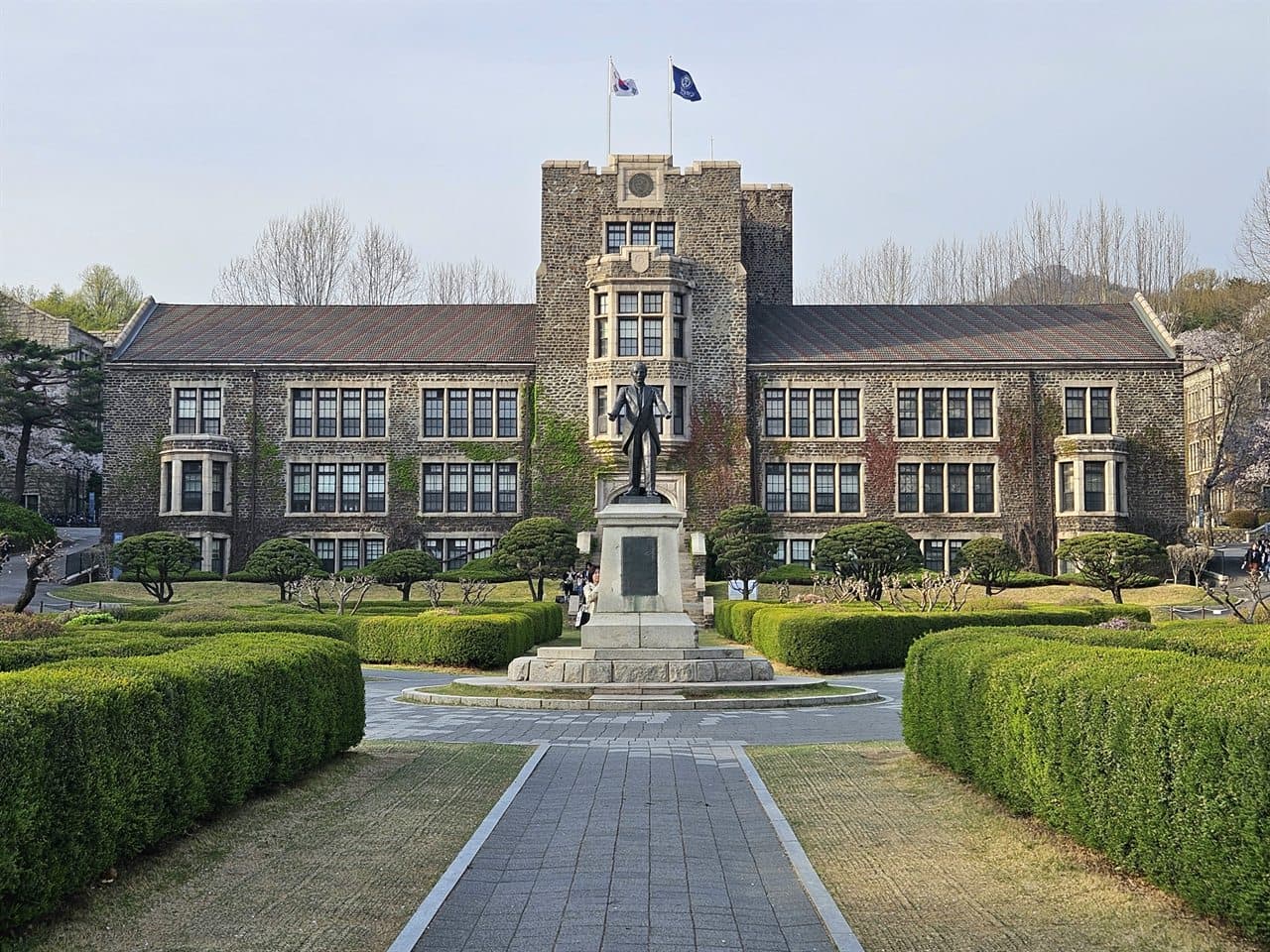
Underwood Hall at Yonsei University in Seoul, a stone building behind a statue and clipped hedges
Underwood Hall, Yonsei University, Seoul · Photo: Kimhs5400 / Wikimedia Commons, CC BY 4.0. Resized.

START WITH YOUR QUALIFICATION

Korean universities admit you on your school record or the CSAT, and universities abroad set their own rules.

At a Korean high school, you apply to Korean universities in two rounds: an early round (수시), based on your school record or a university’s own tests, and a regular round (정시), based mainly on your CSAT results. With the IB, an American diploma, or A Levels, universities abroad look at your results, your school’s grading, and your subjects.

  • KOREAN CURRICULUM

    A Korean high school diploma and the CSAT (수능)

    You finish a Korean high school with your school record (학생부), and you sit the College Scholastic Ability Test in November of your final year.

    U.S. colleges
    Read your school record in context, plus test scores such as the SAT or ACT where they ask for them.
    UK universities
    Oxford doesn’t accept the Korean high school diploma. Cambridge says it won’t be competitive on its own and suggests adding A Levels, the IB, or AP exams.
  • INTERNATIONAL BACCALAUREATE

    The IB Diploma

    You take six subjects, three or four at Higher Level, plus the core. Your teachers predict your grades before the final exams in May.

    U.S. colleges
    Look at your courses, grades, and predicted results in the context of your school.
    UK universities
    Usually set offers in total points and grades in named Higher Level subjects.
  • AMERICAN CURRICULUM

    A high-school diploma with AP courses

    Your school’s diploma and GPA, usually with Advanced Placement (AP) courses and exams.

    U.S. colleges
    Read it much as they would a U.S. school’s record, alongside your school profile.
    UK universities
    Look at your AP exam results. Cambridge typically looks for at least five AP scores of 5 in subjects related to your course.
  • BRITISH CURRICULUM

    IGCSEs, then A Levels

    You usually take three or four A Levels in your last two years, with an exam board such as Cambridge International or Pearson Edexcel.

    U.S. colleges
    Read your IGCSE results, your A Level subjects, and your predicted grades.
    UK universities
    Set offers in A Level grades, often in particular subjects.

Letrado’s adviceAsk your counselor for your school profile early. It explains your curriculum and grading, and U.S. colleges read it alongside your transcript. At a Korean high school, ask how your school issues your record in English.

If you’re taking the CSAT

The exam: The 2027 CSAT is on Thursday, November 19, 2026. It covers Korean, mathematics, English, Korean history (required for everyone), inquiry subjects in social studies, science, or vocational fields, and a second foreign language or Chinese characters.

Results: Results arrive on Friday, December 11, 2026. Each area shows a standard score, percentile, and grade, except English, Korean history, and the second foreign language or Chinese characters, which show a grade only.

The early round (수시), from September: You apply before the CSAT and can make up to six applications in total. Two tracks at the same university count as two. For 2027 entry, universities took applications between September 7 and 11, 2026, and announce results by December 18. In this round, the CSAT can count only as a minimum grade requirement.

If you get an early-round offer: You can’t apply in the regular round that year, even if you don’t register. This includes offers from a waiting list.

The regular round (정시), after results: You apply between January 4 and 7, 2027, once in each of three groups (가, 나, and 다). Universities announce results by February 5.

Oxford and Cambridge: Oxford doesn’t accept the diploma. Cambridge’s suitable options include A Levels, the IB, or at least five AP exams at grade 5 with an overall 수 (90%) in your diploma.
If you’re at an international school

Applying in Korea: Yonsei’s Underwood International College (UIC), for example, has separate tracks. Korean students, including overseas Koreans, start in March.

UIC’s international track: It’s open only if neither you nor either of your parents holds Korean citizenship, including as a dual citizen.

What that track asks for: Documents in English and an interview if you’re shortlisted. SAT, ACT, A Level, IB, or AP results aren’t required, but UIC strongly recommends them. You can start in March or September.

Testing for U.S. colleges: Harvard requires the SAT or ACT for fall 2027 entry, so check test dates and centers early.

COMPARE THE SYSTEMS

The U.S., the UK, and South Korea read your application in different ways.

You can apply to all three in the same year, and we help with all three. Each has its own application, deadlines, and idea of a strong applicant, so give each one its own plan.

UNITED STATES

Colleges read your whole record in context.

Selective colleges look at your grades in the context of your school, alongside your essays, activities, teacher and counselor letters, and test scores where they ask for them. You apply to each college separately, often through the Common App.

Letrado’s adviceMake sure your school profile and counselor letter explain your curriculum. Then use your essays for what only you can say.

UNITED KINGDOM

UK universities admit you to one course.

You apply through UCAS to up to five courses, with one personal statement for all of them. Universities look closely at your subjects and predicted grades, and some courses add an admissions test or interview.

Letrado’s adviceChoose a subject you’d enjoy studying for three years, then check each course’s subject requirements before anything else.

SOUTH KOREA

Korean universities admit students in an early round and a regular round.

In the early round (수시), you make up to six applications in September, and universities look at your school record or set their own tests. In the regular round (정시), you apply in January with your CSAT results, once in each of three groups. An early-round offer rules you out of the regular round, and you can register at only one university.

Letrado’s adviceApply in the early round only where you’d be glad to go, because any offer, even from a waiting list, rules out the regular round that year.

Free help is available, too.

EducationUSA Korea is the U.S. government’s official study-advising center in Korea, and it says its advising and seminars are free.

PLAN YOUR YEAR

Put every system on one calendar, because the dates overlap.

U.S., UK, and Korean deadlines, results, and offers fall at different times. Seeing them together shows where you may need to decide before every result is in.

  • U.S.
  • UK
  • South Korea
  • Exam results
  1. October 2026

    • UK Oct 15

      UCAS deadline for Oxford, Cambridge, and most medicine, dentistry, and veterinary courses

      18:00 UK time.

  2. November 2026

    • U.S. Nov 1

      Early deadlines at Harvard, Yale, and Columbia

      Other U.S. colleges set their own early dates.

    • South Korea Nov 19

      The 2027 CSAT (수능)

  3. December 2026

    • Exam results Dec 11

      CSAT results

    • U.S. Mid-December

      Early decisions from Harvard, Yale, and Columbia

    • South Korea By Dec 18

      Early-round (수시) results

    • South Korea Dec 21–23

      Register for an early-round place

      Offers from waiting lists follow until December 29.

  4. January 2027

    • U.S. Jan 1–2

      Regular deadlines at Harvard, Columbia, and Yale

      Harvard’s and Columbia’s are January 1, and Yale’s is January 2.

    • South Korea Jan 4–7

      Apply in the regular round (정시)

      Once in each group: 가, 나, and 다.

    • UK Jan 13

      UCAS deadline for most other courses

      18:00 UK time.

  5. February 2027

    • South Korea By Feb 5

      Regular-round results

    • South Korea Feb 10–12

      Register for a regular-round place

      Weeks before U.S. regular decisions arrive.

  6. March 2027

    • U.S. Late March

      Regular decisions from Harvard, Yale, and Columbia

      Harvard’s come by the end of March, and Yale’s and Columbia’s in late March.

  7. May 2027

    • U.S. May 1

      Reply to U.S. offers

      The usual U.S. reply date, including at Harvard, Yale, and Columbia.

  8. July 2027

    • Exam results Early July

      IB results

      In 2026 they came out on July 6.

U.S. dates vary by college, so check each college’s own page. Each Korean university sets its own days within these national windows, in its admissions guide (모집요강).

TRY THIS WITH EACH UNIVERSITY ON YOUR LIST

A good list shows why each choice belongs on it.

Open each university’s own pages and note an answer for every row. Bring the gaps and questions to our conversation, or work through them with your counselor.

A worksheet for checking each university on your list
What to checkWhat to note for each university
Your qualificationDoes it accept the Korean diploma or the certificate you’ll finish with, for direct entry?
Subjects and testsWhich subjects, grades, English tests, or admissions tests does the course need?
DatesWhen is the deadline, when will you hear back, and when must you reply or register?
Full cost in wonTuition, housing, flights, insurance, and visas for the whole degree, and again with a weaker won.
Would you go?If this were your only offer, would you be glad to go?

PLAN THE COST

Budget for the whole degree in won, then test it with a weaker won.

A U.S. bachelor’s degree usually takes four years, and many UK degrees take three. Exchange rates can change over that time, so plan for the full degree, not just the first year.

YOUR YEARLY BUDGET

Count everything you’ll pay each year.

  • Tuition and feesThe international fee for your UK course, or a U.S. college’s full published cost of attendance.
  • Housing and foodAt many U.S. colleges, first-year students live on campus.
  • Health coverA UK Student visa includes the Immigration Health Surcharge of £776 a year. U.S. colleges set their own health insurance rules, and many offer a student plan.
  • VisasA UK Student visa costs £558. A U.S. student visa costs $185, plus the $350 SEVIS fee.
  • Flights and depositsFlights home each year, and any deposit a university asks for to hold your place.

Letrado’s adviceRun your budget twice: once at today’s exchange rate and once with the won 10% weaker. Keep at least one option that still works.

Aid depends on your citizenship, not only where you live.

  • If you’re a Korean or other non-U.S. citizenAid for international students differs a lot between colleges. Yale doesn’t consider your family’s ability to pay, wherever you’re from, and asks for the CSS Profile, where you can enter your family’s figures in won. Harvard says its admissions and aid processes are the same for every applicant, whatever your citizenship.
  • At ColumbiaIf you’re an international applicant, Columbia considers your need for aid when deciding whether to admit you, and it meets the full need of those it admits. Ask for aid when you apply, or you can’t later unless your citizenship changes.
  • If you’re a U.S. citizen living in South KoreaU.S. federal student aid depends on citizenship, so you can file the FAFSA with an address in South Korea. Colleges’ own aid may also treat you as a U.S. applicant, so check each college.
  • In the UKYou’ll usually pay the international fee. Fee status depends on your immigration status and where you’ve lived, not where you went to school, so check UKCISA if you’re unsure.
Visas: when to apply

UK Student visa: You can apply up to six months before your course starts, and a decision usually takes about three weeks. You pay the health surcharge for every year of your visa when you apply.

U.S. student (F-1) visa: You apply once your college has sent your I-20 form. If you’re a U.S. citizen, you don’t need one.

Military service, if you’re a Korean man

From 18: On January 1 of the year you turn 18, you’re listed as preparing for military service (병역준비역). The Military Manpower Administration (MMA) counts your age as the current year minus your birth year.

Permission to be abroad: If you haven’t yet served, from the year you turn 25 you need the MMA’s permission to travel or stay abroad. If you’re already abroad, apply by January 15 of that year.

If you’re studying abroad: Permission for study can run from six months before your course starts to six months after you’re due to graduate. While you’re enrolled, it can’t go beyond the MMA’s age limit for your level of study plus one year. You can apply at a regional MMA office, online, or at the Korean embassy or consulate for where you live.

Postponing enlistment: If you’re at a university abroad, you apply to your regional MMA office yourself to postpone enlistment.

Your own situation: Call the MMA’s helpline, 1588-9090, with questions about your own dates.

A STUDENT FROM SEOUL · H.J.

H.J. kept one voice across two very different systems.

H.J. is a Korean student who went to an international school in Seoul. She loved literature, translation, and statistics, and she applied to Oxford for English and to U.S. universities in the same year.

For Oxford, she showed close reading.

She wrote a focused academic statement and chose written work that showed how she reads a text closely.

For U.S. colleges, she wrote about a subtitle.

Her essay was about a school performance where the actor couldn’t deliver her most literal translation naturally. Revising it meant balancing accuracy, rhythm, and audience.

She cut the sentences she’d never say.

Her early drafts tried to sound like a published critic. Reading them aloud, she dropped the ornate lines and kept her own dry humor.

Different systems can ask for different evidence without asking you to become someone else.

HER OFFERS

  • Harvard University
  • University of Oxford
  • Yale University
  • Columbia University
Yale’s Harkness Tower framed by treesHER CHOICE: YALE

Yale University · Photo: Carol M. Highsmith / Wikimedia Commons, Public domain. Cropped.

She chose Yale for demanding humanities with room for statistics.

Oxford offered the most concentrated literary training, and Columbia a strong core in New York. Yale let her take on demanding humanities work while keeping statistics open before committing to a fixed combination. Her parents supported the choice after reviewing the curriculum and financial package.

An anonymized client journey, shared with initials to protect privacy.

Read H.J.’s full story Read our Oxford guide

WHEN YOU’D LIKE A HAND

A conversation can help you find a useful place to start.

Bring your questions to a free 45-minute introduction with your proposed mentor. Afterward, we’ll email a personalized plan with recommended next steps.

Official sources are linked beside the relevant guidance.

KCUE’s 2027 admissions rules (Korean) (opens in a new tab)