SMALL BY DESIGN Every student gets our full attention. Read our story →
All graduate guides

HGSE LEARNING DESIGN · GRADUATE STUDY GUIDE

Planning to study learning design at Harvard? Be sure it’s the one program you want; its online start is in June 2027.

The Harvard Graduate School of Education (HGSE) has one residential Master of Education (Ed.M.) with five Programs. Apply through Learning Design, Innovation, and Technology (LDIT) if you want to create learning materials and experiences, in fields such as educational technology.

Fall 2027 entry, starting online in early June

A long red-brick building with tall arched windows and a stone stair, behind a lawn and a tree with red autumn leaves
The Harvard Graduate School of Education in Cambridge · Photo: ajay_suresh / Wikimedia Commons, CC BY 4.0. Resized and cropped.

GET TO KNOW THE PROGRAM

Take HGSE’s four Foundations courses, LDIT’s own courses, and electives you choose, in one full-time year.

Your year runs from the June, July, and August courses through spring, and you need at least 42 credits.

FOUNDATIONS

Start with four courses every Ed.M. student takes.

How People Learn runs online in June and July and takes about 12 to 15 hours a week, including assignments. The other three follow in Cambridge in August.

LDIT

Take at least 12 credits in LDIT itself.

That’s the 4-credit Program Core Experience in the fall, plus 8 credits from more than 30 courses taught by LDIT faculty.

ELECTIVES

Choose the rest of your courses yourself.

You can take up to 16 credits at other Harvard schools or MIT. After you enroll, you can also add a Concentration, an optional specialization of 8 to 12 credits, such as Higher Education.

Build hands-on design work into your course choices.

Up to 8 credits can be independent study or field experience, and the Ed.M. needs no thesis or comprehensive exam, HGSE’s 2026–27 handbook says. The LDIT page names no required internship, practicum, or capstone.

LDIT’s courses, Concentrations, and cross-registration

LDIT’s courses: The fall core covers designing learning for settings such as classrooms, conferences, and online networks. Other LDIT courses take up topics such as deeper learning, learning analytics, universal design, and entrepreneurship in education.

Concentrations: They can change each year, so check HGSE’s page for the 2027–28 list once it’s posted.

Cross-registration: MIT’s spring grades may arrive too late to count for May graduation.

Part-time study, health insurance, and careers

Part time: Some residential students are approved to study part time over two years, at a half-time tuition rate with the same total. Ask HGSE admissions how to get that approval. Students on F-1 or J-1 visas must enroll full time.

Health insurance: You can waive Harvard’s Student Health Insurance Plan, not its Student Health Fee, if you judge your own coverage comparable. Check the fall 2027 waiver deadline once it’s posted.

Careers: HGSE lists paths such as learning technologist and user-experience designer. Its Class of 2024 report, covering all HGSE degrees, says “85% employed successfully as of September 2024.” HGSE knew the outcomes of 85% of that class.

Studying here on an F-1 student or J-1 exchange visa

Your visa: HGSE sends visa information soon after you’re admitted, and the Harvard International Office (HIO) notes that a U.S. consulate still decides each visa.

Your start date: You start online in June but must be in Cambridge by August 2, and F-1 students can’t enter the U.S. more than 30 days before their start date, so ask the HIO which date your visa form will show.

Working during the year: F-1 rules cap campus work at 20 hours a week during term, and off-campus work needs approval before it starts, so talk to the HIO before counting on it.

Enrolling at Harvard on a visa: Court orders let Harvard keep enrolling students from abroad and issuing their visa forms, the HIO says in an FAQ last updated January 7, 2026. It adds that Harvard could still lose that ability.

Entry restrictions by nationality: Proclamations of June 4 and December 16, 2025, limit U.S. entry for people from more than 30 countries. The HIO links the lists and says the State Department will likely decline their visa applications.

Your stay in the U.S.: Under “Duration of Status,” F and J students can stay as long as they study or work on OPT. On September 14, 2026, a federal judge blocked a rule replacing it with a fixed stay, though not permanently, the HIO says.

Before you decide: Read the HIO’s FAQ and news before you apply, and again before you reply to an offer.

A pale concrete building with long bands of windows on a street corner, behind bare trees
Gutman Library, Harvard Graduate School of Education · Photo: ajay_suresh / Wikimedia Commons, CC BY 4.0. Resized and cropped.

UNDERSTAND WHAT HGSE LOOKS FOR

Explain why you’re pursuing a master’s in education, and connect it to your past work and future goals.

HGSE looks for a passion for education, varied life and work experience, and a deep commitment to making an impact. You don’t need experience in an education job, and the Graduate Record Examinations (GRE) are optional.

YOUR EXPERIENCE

Show work that helped people learn, in any setting, not just a classroom.

HGSE defines education broadly. Residential Ed.M. students who entered in 2024–25 had 0 to 34 years of work, 4.1 on average, though profiles vary by program.

Letrado’s adviceHGSE leaves your résumé’s length and format to you, so give each learning project its own line, like training you designed or lessons you led as a volunteer.

YOUR PROGRAM

Choose LDIT on purpose: it’s your only HGSE application for 2027–28.

HGSE takes one application per person each academic year, and it says Program changes after an offer are “rare.”

Letrado’s adviceRead the other four Programs’ pages first. If one fits your goals as well as LDIT, settle your choice before you write.

YOUR LETTERS

Pick three recommenders from your studies and your work, then leave the letters to them.

HGSE prefers a mix of academic and professional recommenders, or all professional if years have passed since your last course. Family members can’t write your letters, and personal friends shouldn’t.

Letrado’s adviceSend each recommender your résumé or a summary of your accomplishments, plus your statement of purpose, all of which HGSE allows.

Your 42 credits: what’s required and what you choose

HOW THE CREDITS WORK

Beyond the required courses, you choose your own electives.

42credits at least, to earn the Ed.M.
12credits at least in LDIT itself
Up to 16credits at other Harvard schools, MIT, and a few others
8–12credits for an optional Concentration
Your essays, your letters, and HGSE’s limits on AI

WHAT HGSE ALLOWS

For your statement, HGSE permits AI “only for assisting with edits and/or identifying grammatical errors.”

Your statement

Its content “must be your own.”

Your letters

You may not help draft or submit them, and you’ll sign a statement saying you didn’t.

Others’ work

Cite any quotes or ideas you use. Citations don’t count toward your statement’s word limit.

A red-brick building with white columns, an arched white doorway, and rows of tall windows
Longfellow Hall, Harvard University · Photo: John Phelan / Wikimedia Commons, CC BY 3.0. Resized and cropped.

PLAN THE APPLICATION

The whole application, letters included, is due January 5, 2027, and a few days early is safer.

You apply through HGSE’s own online application.

Ed.M. application deadline

Jan 5, 2027
Time
Not printed
Fee
$85

Virtual interviews, by invitation

Jan or Feb

HGSE aid application

Feb 12, 2027
Form ready
By end of January 2027

Ed.M. decisions

Early March 2027

Enrollment response

Apr 15, 2027

Online start

Early June 2027

In Cambridge by

Aug 2, 2027

Facts checked against official pages on November 7, 2026.

HGSE says not being invited to interview is “not an indicator of admissibility,” and it lists the interview window without a year.

Have these six pieces ready.

  • The online application and fee

    An $85 fee that isn’t refunded. For a waiver, use the form inside the application and attach proof of financial need.

  • Statement of purpose

    Up to 1,000 words, on the prompt below.

  • A short essay on disagreement

    Up to 500 words, required of every Ed.M. applicant.

  • Three letters of recommendation

    Sent through HGSE’s system, not services such as Interfolio. You can’t change recommenders once you’ve entered them.

  • Résumé or CV, and transcripts

    Unofficial transcripts from each college or university, including any non-degree classes.

  • English test and video, if English isn’t your first language

    A Test of English as a Foreign Language (TOEFL), International English Language Testing System (IELTS) Academic, or Duolingo English Test score, unless you’re exempt, plus a 120-second video, even if you are.

English tests, the GRE, and transcripts

Exempt from English tests: Native English speakers, and anyone whose bachelor’s degree took at least three years of full-time study at a college or university that taught only in English. An English major or an English-taught graduate degree doesn’t exempt you.

Scores HGSE prefers: TOEFL iBT taken before January 21, 2026: 104 or higher, with at least 26 in each section. After that date, on the new 1-to-6 scale: 5.0 or higher overall and in each section. IELTS Academic: 7.5 overall and in each section. Duolingo English Test: 140.

Sending scores: Tests must date from January 1, 2025, or later. HGSE’s institution code is 3428, with no department code.

The GRE: Optional. If you send scores, the test must be from January 1, 2022, or later.

Transcripts: Records in other languages need certified, word-for-word translations, and you can’t translate your own. If you’re admitted with a degree from outside the U.S., you’ll have your records verified through World Education Services, Educational Credential Evaluators, or SpanTran.
Replying, deferring, applying again, and sanctions

If you’re admitted: Ask HGSE what’s due with your enrollment response, since its pages mention no deposit.

Deferring: HGSE’s Public Service Priority Pathway is for people serving a full-time term of at least 10 months with a Teach For All partner, the Peace Corps, or AmeriCorps programs such as City Year and Teach For America. They can be admitted and start after their service, with no application fee. Others should ask HGSE.

Applying again: HGSE accepts at most three applications from one person in a lifetime. If you applied for 2024–25 or later, you can reuse some documents but need an updated statement and résumé and at least one new letter; earlier applicants start over.

Sanctions: Harvard bars people living in comprehensively sanctioned regions, or otherwise under U.S. sanctions, from its programs unless a license or exemption applies.

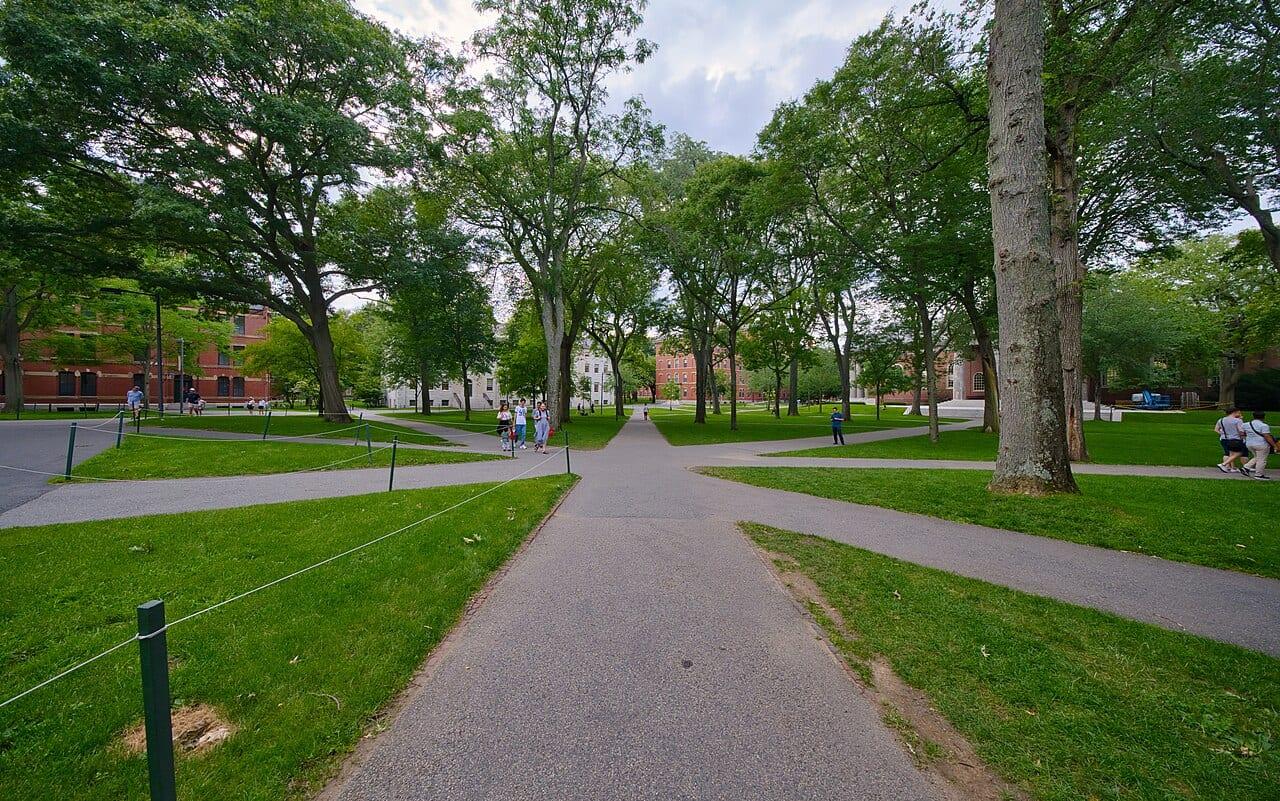
A wide sunny lawn with a large tree, framed by brick buildings with white trim and a small cupola
Radcliffe Yard, Harvard University · Photo: John Phelan / Wikimedia Commons, CC BY 3.0. Resized and cropped.

WRITE IN YOUR OWN VOICE

Write a statement on your goals, and a short essay on a time someone challenged your values.

1,000 and 500 wordsThe limits for your statement and your short essay.

HGSE says you don’t need to name faculty or courses, but the strongest statements are specific to HGSE.

Letrado’s adviceCenter your statement on one learning problem: what learners needed, what you made, and how you judged whether it worked, the first three skills LDIT lists. In the short essay, tell the disagreement briefly and focus on what it taught you.

Statement of purpose · up to 1,000 words

Explain your background, your goals, and your fit with LDIT.

HGSE asks which experiences motivate you and show your commitment to education. It asks for your professional goals and how graduate study will move you toward them. Then it asks how enrolling in LDIT will help, naming the knowledge, skills, and experiences you’d pursue at HGSE.

Required short essay · up to 500 words

Describe a time someone challenged a belief or value you hold.

HGSE asks what the situation taught you about yourself, others, and constructive conversations, and how those lessons might carry over to education issues you care about or your time at HGSE.

Video response · 120 seconds, for non-native English speakers

Answer an education question on video.

You see the question only in the application’s Video Response section.

A brick building with a white cupola and an arched window, framed by trees in autumn color
The Radcliffe Gymnasium in Radcliffe Yard, Harvard University · Photo: Daderot / Wikimedia Commons, CC0. Resized and cropped.

MAKE ROOM FOR THE FINANCIAL QUESTION

Use the 2026–27 tuition of $64,428 to plan until HGSE publishes its 2027–28 rates, due in March 2027.

To be considered for most HGSE grants and fellowships, file its aid application by February 12, 2027. HGSE offers no tuition waivers.

NEED-BASED GRANT

Up to $23,000

HGSE’s current maximum for full-time students, awarded on financial need.

FELLOWSHIPS

Close to half of tuition

The Barakett and Leadership in Education fellowships weigh financial need and are open to international students.

URBAN SCHOLARS FELLOWSHIP

Full tuition

It also covers health insurance fees. To be considered, you need at least three years of direct work or significant volunteering in urban education, and international students can apply.

Awards go toward billed tuition unless HGSE says otherwise.

HGSE’s fellowships and grants (opens in a new tab)

PUBLISHED 2026–27 TUITION · FULL-TIME ED.M.

$64,428

HGSE’s standard 2026–27 budget for 10 months of full-time study is $106,196. Tuition and health insurance are billed; the other lines are estimates.

See the 2026–27 budget
Tuition
$64,428
Housing and food
$27,825
Student Health Insurance Plan (waivable with comparable coverage)
$4,954
Student Health Fee
$1,944
Books, course materials, supplies, and equipment, including the HGSE document fee
$330
Personal expenses
$4,714
Transportation
$1,590
Student activity fee
$75
Graduation fee, in your final term
$120
Federal loan fees (U.S. citizens and permanent residents only)
$216
Standard budget, 10 months
$106,196

Your year starts in June, so ask HGSE whether the summer changes the 10-month budget. Part-time tuition is $32,214 a year in 2026–27.

HGSE’s tuition and costs (opens in a new tab)

Line up loans and outside funding alongside HGSE’s aid.

  • HGSE’s aid applicationU.S. citizens and permanent residents also file the Free Application for Federal Student Aid (FAFSA) by February 12, 2027, with HGSE’s code, E00213. Late forms are accepted, but on-time ones get priority.
  • If you graduated from Harvard or Radcliffe CollegeThe Pforzheimer Fellowship, for U.S. citizens and permanent residents committed to public service, also asks for a short public-service statement and your résumé by February 12, 2027.
  • U.S. federal loansHGSE prints a $20,500 yearly maximum for Direct Unsubsidized Loans, and Graduate PLUS loans ended for new students on July 1, 2026. Ask HGSE about 2027–28 rates and whether the Ed.M. counts as a professional degree for federal limits.
  • Private loansFor 2026–27, HGSE’s full-time U.S. students could borrow up to $26,000 through the Harvard Federal Credit Union and up to their budget minus their aid through College Ave, Harvard’s preferred lenders. International students could borrow up to $26,000 through either, usually with a creditworthy U.S.-citizen co-signer.
  • If you’re an international studentYou can be considered for HGSE’s need-based and scholarship aid, but not for U.S. federal loans. HGSE says international students “must rely on significant personal resources and funding from their home nation,” and names outside sources such as Fundación México en Harvard and Fundação Estudar.
  • Funds for your visaBefore Harvard issues your visa documents, you prove funding for one year: in 2026–27, $105,980 plus return airfare for a single student. A spouse adds $28,071, which can’t come from HGSE aid.
  • Work during the yearHGSE says U.S. citizens and permanent residents with Federal Work-Study can reasonably expect to earn up to $5,000 a year, while international students often find campus jobs hard to get. Ask HGSE about assistantships, since its aid pages name none.

Letrado’s adviceFile HGSE’s aid application even if you doubt you’ll qualify.

ADMITTED TO HGSE · L.W.

L.W. learned that a teacher’s habit of explaining more can hide a design tool that doesn’t work.

L.W. came from a middle-school math classroom. She had created materials for teachers, but nothing commercial, and she had no credential in user research. Her application had to answer two questions: why her students had given up on a practice platform, and what her career plans were.

Her first essay jumped straight to software.

It proposed an ambitious platform for adaptive learning before she had checked whether software fit the problem she’d seen in class.

She corrected her first reading of the problem.

Reviewing the platform, she saw she had blamed low use on students’ motivation, not on unclear feedback and spotty internet access.

She kept her goals open and made no promise to go back to her old job.

She meant to stay in education, and she still had to show why graduate study made sense now.

HGSE’s statement prompt (opens in a new tab) asks for your professional goals and how graduate study in education will contribute to them. If, like L.W., you want to keep your career options open, make your reason for studying now concrete.

AI illustration

L.W. · MIDDLE-SCHOOL MATH TEACHER

She kept each version of her teacher materials, and they became a simple portfolio.

Read L.W.’s full story
Harvard University

HER HARVARD OUTCOME

Offered a place in Harvard’s Ed.M. in Learning Design, Innovation, and Technology
Stanford’s Main Quad, with red-tiled roofs and courtyardsHER CHOICE: STANFORD

Main Quad, Stanford University · Photo: Steve Jurvetson / Wikimedia Commons, CC BY 2.0. Cropped.

She picked Stanford’s MS in Learning Design and Technology over Harvard’s greater flexibility.

The program’s design emphasis and structured projects suited the work she most wanted to do.

ALSO ADMITTED TO

  • Stanford University
  • University of Pennsylvania

Anonymized client journeys, shared with initials to protect privacy. Portraits are AI illustrations, not photographs of our clients.

Browse all client journeys

WHEN YOU’D LIKE A HAND

A conversation can help you find a useful place to start.

Bring your questions to a free 45-minute introduction with your proposed mentor. Afterward, we’ll email a personalized plan with recommended next steps.

Official HGSE, Harvard University, and U.S. government sources are linked beside the relevant guidance.

HGSE: how to apply (opens in a new tab)