SMALL BY DESIGN Every student gets our full attention. Read our story →
All undergraduate guides

UNDERGRADUATE ADMISSIONS GUIDE

At Sciences Po, you choose a campus and a region, then show how you think.

Sciences Po’s bachelor’s degree mixes history, law, economics, political science, and sociology, taught in French and English on seven campuses across France. Start here to understand the degree, choose your programs, and prepare each stage of the application.

September 2027 entry

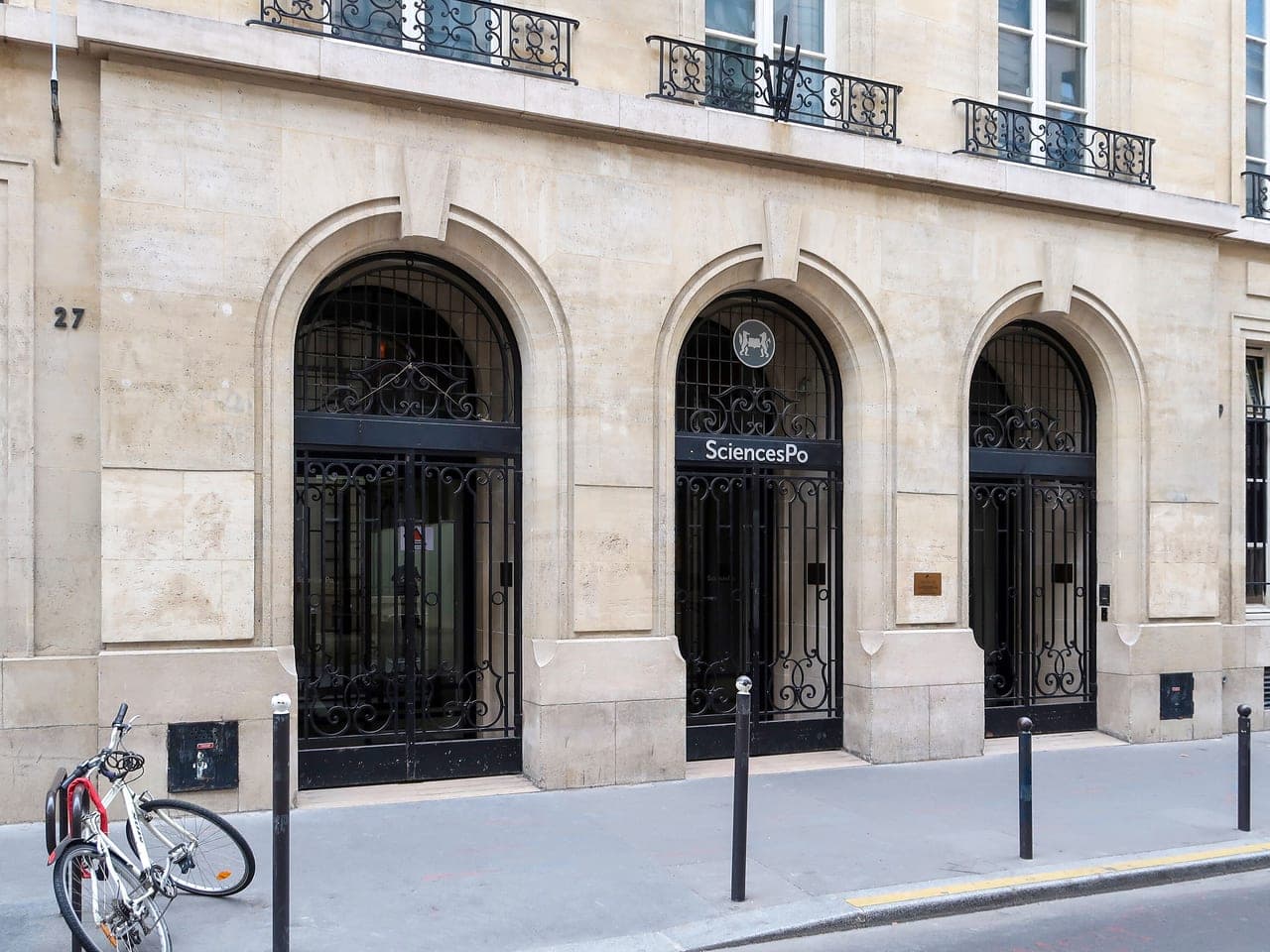
The arched stone entrance of Sciences Po at 27 rue Saint-Guillaume in Paris
27 rue Saint-Guillaume, Paris · Photo: Celette / Wikimedia Commons, CC BY-SA 4.0. Resized and cropped.

GET TO KNOW THE DEGREE

Three years of social sciences, with a campus that gives you a region.

The Bachelor of Arts is a three-year degree of at least 180 ECTS credits (the European credit system), taught in French and English. Every student studies the same core disciplines. Your campus adds a minor focused on one part of the world.

FIRST YEAR

Learn every discipline.

Courses introduce history, law, economics, political science, sociology, and the political humanities.

SECOND YEAR

Choose two majors.

One from economics or political science, and one from law, history, or sociology.

THIRD YEAR

Study abroad.

A full year at a partner university, or one semester of study and one of full-time internship.

Your campus decides your region and your language.

Each regional campus teaches a geographic minor, such as Asia-Pacific in Le Havre or North America in Reims. You spend your first two years there.

The six regional campuses, their regions, and their languages

Le Havre: Asia-Pacific, taught in English.

Reims: North America, taught in English, or Africa, taught in French and English.

Menton: The Mediterranean and the Middle East, taught in French or in English.

Dijon: The European Union, with Central and Eastern Europe, taught in French. You can take your first semester in English.

Nancy: The European Union and the Franco-German partnership, taught in French, with the same first-semester English option.

Poitiers: Latin America and the Caribbean, taught in French, with the same first-semester English option.

Paris: A general program with no regional focus, taught in French. It isn’t open through the international route described in this guide.

Dual bachelor’s degrees with universities abroad

The partners: Sciences Po runs dual bachelor’s degrees with Columbia, UC Berkeley, the University of British Columbia, University College London, the University of Sydney, the National University of Singapore, the University of Hong Kong, Keio University, Freie Universität Berlin, Luiss, and FGV in São Paulo.

How they work: With Columbia or Berkeley, you spend two years on the Le Havre, Menton, or Reims campus, then two years in the United States, and earn a degree from each university.

Where you apply: It depends on the program. You apply to the Columbia and Berkeley programs on those universities’ own websites, and for Berlin, Hong Kong, Keio, and Luiss on Sciences Po’s platform.

Which route is yours: the international route or Parcoursup

Your diploma decides: The international route is for students preparing a non-French diploma, such as the IB, A levels, the Abitur, or a U.S. high school diploma. Your nationality doesn’t matter.

French baccalaureate students: If you’re preparing the French baccalaureate, including at a French school abroad, you apply through Parcoursup, France’s national platform for applying to university, even if you’re also preparing another diploma.

If you’ve already graduated: If you finished secondary school between October 2025 and September 2026, you must ask Sciences Po for a dispensation before you apply.

One application only: Sciences Po says you can’t apply to its Undergraduate College more than once, and the €150 fee isn’t refunded, so check your eligibility first.

UNDERSTAND WHAT SCIENCES PO CONSIDERS

Your file earns you an interview. The interview completes your mark.

Sciences Po scores every application out of 100. Three evaluations of your written file give up to 50 points. If you reach the year’s minimum mark, you’re invited to a remote interview worth the other 50.

YOUR RESULTS

Two examiners read your school record.

One marks your exam results or predicted grades. A second, who doesn’t see the first mark, reads three years of your record for your progress, activities, and interests. There are no required subjects.

Letrado’s adviceTake the subjects you’re genuinely good at; an IB student without a science isn’t disadvantaged. Show your interest in history and current affairs through what you read and do.

YOUR WRITING

Three short answers show how you think.

Your written motivations are marked out of 10. Interviewers can read them too and may ask about what you wrote.

Letrado’s adviceWrite about books, places, and questions you know well, because you may have to discuss them on camera.

YOUR INTERVIEW

About 25 minutes, with an image to analyze.

Two examiners, who can read your written answers but don’t see your other marks, judge how you discuss, respond to questions, and reason.

Letrado’s advicePractice describing and interpreting images you’ve never seen before, out loud, with a timer.

How the interview works, minute by minute

WHAT SCIENCES PO DESCRIBES

A remote interview in three parts, lasting about 25 minutes.

Up to 2 minutes

You introduce your background, experience, and ambitions, without reading a text.

10–15 minutes

You choose one of two images, explain your choice, then describe, contextualize, and analyze it.

5–10 minutes

An open discussion of your motivations and your plans for study.

The images can be paintings, drawings, photographs, newspaper front pages, graffiti, comic strips, or caricatures. The examiners aren’t looking for one specific answer, but for the main issues the image raises. No one else may be in the room, and missing your interview means rejection.

How your marks add up

HOW SCIENCES PO SCORES

Two minimum marks, set each year after the results are in.

20points for your exam results or predicted grades.
20points for your academic record and progress.
10points for your written motivations.
50points for your interview.

Your file needs a minimum mark to reach the interview, and your total needs a second minimum for admission. The jury sets both each year from the applications it receives, so there’s no published cutoff.

Which language you need, and how Sciences Po checks it

WHAT SCIENCES PO ASKS

C1 in the language of your program, checked in the interview.

For programs taught in English, Sciences Po asks for English at the C1 level of the European framework, an advanced level. For programs taught in French, it asks for French at C1, or French at B1 (intermediate) along with English at C1.

Sending a language test score is optional. Sciences Po assesses your languages during the admissions process, especially in the interview, and this can affect your marks. You write your answers in the language of each program you choose.

What Sciences Po says about AI and outside help

WHAT SCIENCES PO SAYS

Your written answers must be yours alone.

Sciences Po asks that your writing be “honest, sincere” and that you have prepared it “alone without any outside help.” It warns that texts prepared with the help of a third party or an AI tool such as ChatGPT, or plagiarized texts, “are recognisable and may have disciplinary consequences.” If plagiarism is suspected, an essay may be given a mark of 0.

PLAN THE APPLICATION

Submit early, and you interview and hear back sooner.

You apply on Sciences Po’s own admissions website. Applications are open on a rolling basis until the final deadline, March 1, 2027. The date you submit a complete application, with both references, decides when you interview and get your result.

First results round

Nov 4, 2026
Interviews
Dec 8–18, 2026
Your result
Mid-January 2027

Berkeley dual degree: UC application and supplement

Nov 30, 2026
Interviews
January to February 2027
Decision
February 2027

Columbia dual BA

Jan 2, 2027
Interviews
Mid-February to mid-March
Decision
April 1, 2027
Reply by
May 1, 2027

Second results round and Émile Boutmy Scholarship

Jan 13, 2027
Interviews
Mar 8–19, 2027
Your result
Early April 2027

Final deadline, including dual degrees on Sciences Po’s platform

Mar 1, 2027
Interviews
Apr 13–23, 2027
Your result
Early May 2027

Sciences Po’s deadlines are at 11:59 p.m. Paris time. Its interview dates apply if you’re invited and your application was complete when you submitted it. Columbia and Berkeley set their own dates.

Prepare these pieces together.

  • Two program choices

    Two regional minors, or one dual degree as your first choice plus one minor. If admitted, you’re placed in one of them. The application fee is €150 and isn’t refunded.

  • Your school record

    Transcripts for your last three years and any exam results. IB students add predicted grades. U.S. students add a transcript with an unweighted GPA, the school profile, and AP score reports if you took AP exams. The SAT and ACT are optional.

  • Two academic references

    From teachers or your head of school. Your application is incomplete, and won’t be assessed, without both.

  • A CV and three written answers

    Your CV, in French or English to match your programs, and three answers of 1,500 to 2,000 characters each.

  • A remote interview

    By invitation, if your file reaches the minimum mark.

Applying to the Columbia or Berkeley dual degree

Columbia: You apply through Columbia’s School of General Studies, not the Common Application. You send one essay, two academic recommendations, transcripts, and any required test scores, with an $80 fee. Shortlisted applicants have a 30-minute virtual interview with a panel from both universities.

Columbia’s restrictions: You can’t apply to this program and to Columbia College or Columbia Engineering in the same year. If you applied Early Decision to either, or were rejected by them in the last three years, you’re not eligible.

Berkeley: You submit the standard University of California application and a Sciences Po–UC Berkeley supplement. The supplement asks for an essay of 750 to 1,000 words on your motivations and choice of campus, a résumé, and up to two optional letters of recommendation.

Sciences Po’s own degree: If you also want to apply for one of Sciences Po’s own bachelor’s programs, you apply separately on Sciences Po’s admissions website. Sciences Po says candidates who apply both to the Columbia dual BA and to one of its programs may be invited to two different interviews.

Before and after you submit

Start with your references: Sciences Po advises requesting them first, to give your teachers time.

Check everything twice: Once you submit, your application can’t be changed. Upload each document as a PDF of 2 MB or less.

Your result: An offer depends on your final diploma. If you’re offered both a dual degree and a minor, you choose one.

Scholarships and loans: the details to check while you apply

The Boutmy Scholarship: Dual citizens with an EU nationality, Swiss and Norwegian applicants, and most dual-degree candidates aren’t eligible. It continues through your third year abroad.

European support: Sciences Po’s €400 a year is paid once you’ve registered, and depends on attending your courses.

U.S. federal loans: Sciences Po’s federal loan program covers most of its master’s programs, not the bachelor’s.

Your student visa, if you’re from outside the EU

Études en France: Your Sciences Po application doesn’t go through Campus France, but your visa may. If you live in a country on the Études en France list, including the U.S., the UK, China, India, Japan, and South Korea, your visa process runs through that platform after your offer. France-Visas gives the visa fee as about €50 in those countries and €99 elsewhere.

After you arrive: Your long-stay student visa (VLS-TS) also serves as your residence permit. You validate it online within three months of arriving. It lets you work up to 964 hours a year.

If you’ll be 17: France-Visas’s student visa page says you must be over 18. If you’ll still be 17 when you arrive, ask the French consulate and Sciences Po early which visa applies to you.

WRITE IN YOUR OWN VOICE

Three short answers, written entirely by you.

1,500 to 2,000 characters eachSpaces count. The third answer, about your programs, isn’t graded.

Sciences Po uses your answers to judge your writing and critical thinking. Write each one in the language of instruction of your two programs.

Letrado’s advicePick one real experience and one book you’d happily discuss for ten minutes. Plan early, because Sciences Po asks you to write alone: no AI and no editing from anyone else, including us.

Read Sciences Po’s exact questions (opens in a new tab)
Your personal journey and how you see the world

Connect your experience with Sciences Po’s mission.

Sciences Po asks how your personal journey has shaped your perception of the world, and how that perspective fits its undergraduate program (and a partner university’s, if you’re applying for a dual degree).

A work of literature that shaped your thinking

Choose a book you’ve lived with.

Pick a work that changed how you think, and explain what it changed. A book you can discuss in depth will serve you better than an impressive title.

Your two programs, and why you chose each

Explain each choice on its own terms.

Name the two programs that interest you most and your reasons for each. This answer isn’t graded, but the examiner reads it for context.

Outside help · what Sciences Po says

Prepare these answers alone.

Sciences Po says help from another person or an AI tool is recognizable and may have disciplinary consequences. Write and revise these texts yourself.

MAKE ROOM FOR THE FINANCIAL QUESTION

Your tuition depends on where your family pays tax, not on your passport.

Sciences Po sets tuition by your household’s tax residence. If it’s in the European Economic Area, your fee depends on your family’s income. If it’s outside, including the U.S. and the UK, you pay a set fee.

TAX RESIDENCE IN THE EEA · 2026–27

€0 to €14,900 a year

Calculated from your household’s income. The EEA is the European Union plus Iceland, Liechtenstein, and Norway.

TAX RESIDENCE OUTSIDE THE EEA · 2026–27

€14,900 a year

A set fee for students entering in 2026–27, whatever their nationality.

INTERNATIONAL DUAL DEGREES

Pay the university you’re at

For programs such as Columbia’s or Berkeley’s, you pay tuition to the university where you’re studying that year.

Sciences Po’s board votes each year’s fees in advance, and the 2027–28 fees aren’t published yet. Sciences Po says nearly one in three of its students has a full-fee scholarship.

Sciences Po’s tuition fees (opens in a new tab)

SCIENCES PO’S STUDENT BUDGET GUIDE · PER MONTH

€1,235 or more in Paris

Sciences Po’s minimum monthly estimate for Paris. Rent on the regional campuses is usually lower, such as €205 to €365 for a student residence in Menton, although private rooms in Menton can cost €500 to €700.

See the monthly estimates
Average rent in Paris
€885
Food in Paris
€250–€300
Culture and leisure in Paris
€100–€150
Paris transport pass
€90.80
Rent in Dijon or Nancy
€380–€450
Rent in Le Havre (student residence)
€450
Rent in Menton (student residence)
€205–€365
Rent in Poitiers
€340–€440
Rent in Reims
€400–€600

Sciences Po’s guide doesn’t give a year for these estimates. You also pay the national student-life fee (CVEC), €105 in 2025–26. Flights and visa costs are extra.

Sciences Po’s budget guide (opens in a new tab)

Look for the support that matches your tax residence.

  • The Émile Boutmy Scholarship, from outside the EUFor first-time applicants from outside the EU whose household doesn’t pay tax in the EU. It covers all your tuition or €9,500 of it, and is awarded on merit. You request it in your application. The deadline is January 13, 2027, and Sciences Po accepts no scholarship requests after you submit.
  • Support with EEA tax residenceYour fee already falls with your family’s income. After a year of study in France, European students can apply for France’s needs-based CROUS grant. Students without one whose fee comes to €0 receive €400 a year from Sciences Po.
  • The Henri de Castries Scholarship$10,000 for one year, for U.S. or French citizens entering the Columbia or Berkeley dual degree. The deadline is April 11, 2027.

Letrado’s adviceWork out all three years, plus flights home and your third year abroad. If your plan depends on the Boutmy Scholarship, keep a second option that works without it.

For your visa, you must show at least 47% of France’s gross monthly minimum wage: €877.50 a month for applications made from August 1, 2026.

Légifrance: the resources rule (opens in a new tab)

CLIENT JOURNEYS

Stories from students weighing similar choices.

Here are three related stories. These international students chose between focused and broad study, followed interests that cross subjects, and compared offers in different countries, the same questions Sciences Po applicants weigh.

AI illustration

A similar path

P.N. · History & politics

P.N. chose focused study after comparing two different university experiences.

P.N., a U.S. citizen raised in Thailand, was drawn to history and politics. He weighed focused UK study against broader U.S. options, was admitted to Harvard, Oxford, Yale, and Columbia, and chose Oxford.

Read P.N.’s full story
AI illustration

A similar path

H.J. · Literature & statistics

H.J. found room for both literature and statistics.

H.J., a Korean student at an international school in Seoul, combined literature, translation, and statistics. She was admitted to Harvard, Oxford, Yale, and Columbia, and chose Yale.

Read H.J.’s full story
AI illustration

A similar path

D.K. · Economics & philosophy

D.K.’s essay showed how she learned to question her assumptions.

D.K., at an international IB school in Hong Kong, was drawn to economics, philosophy, and political thought. She compared her four offers for aid and curricular flexibility, and chose Penn.

Read D.K.’s full story

Real journeys, shared with initials to protect privacy. Portraits are AI illustrations, not photographs of our clients.

Browse all client journeys

WHEN YOU’D LIKE A HAND

A conversation can help you find a useful place to start.

Bring your questions to a free 45-minute introduction with your proposed mentor. Afterward, we’ll email a personalized plan with recommended next steps.

Official Sciences Po, Columbia, UC Berkeley, and French government sources are linked beside the relevant guidance.

Sciences Po international undergraduate admissions (opens in a new tab)